
Tents and Trees strategy: distinguish open squares from usable space
Forest Camp is a counting puzzle with an extra spatial constraint: tents need room around them. A row may contain several empty squares and still lack enough space for its required tents. Learning to count usable placements, rather than raw blanks, makes the board easier to read. This guide combines row capacity, tree pairing and diagonal separation, using examples that state their assumptions explicitly.
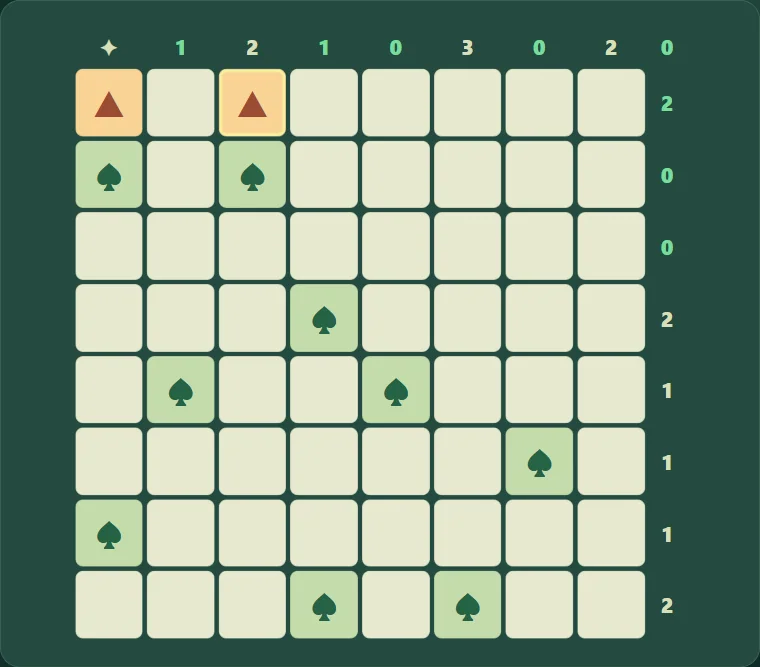
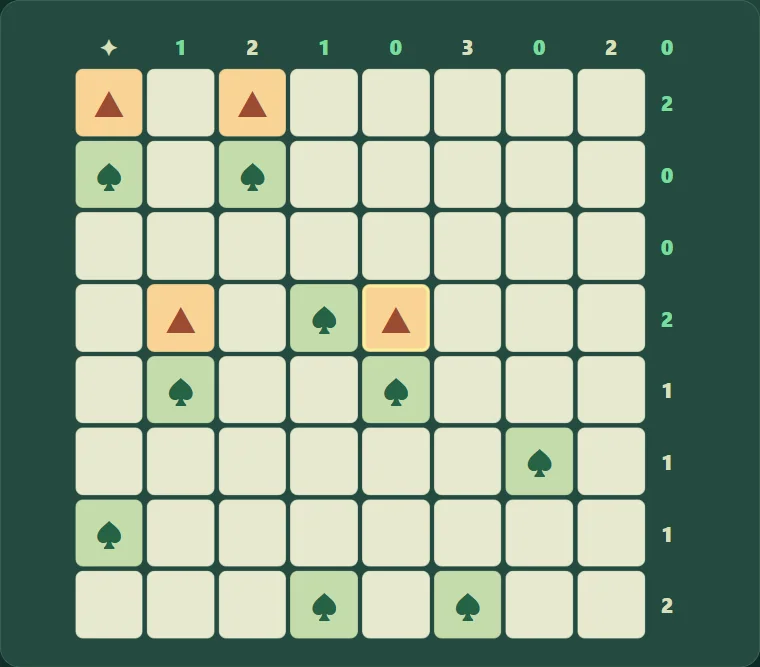
Establish the three obligations
Every tree must be paired with a tent in an orthogonally adjacent square. The tents and trees need a one-to-one matching. A tent can physically touch more than one tree, but it belongs to only one in that matching. Diagonal proximity cannot create a tree-tent pair. This is different from the separation rule, which does include diagonal contact between tents.
No pair of tents may touch through a side or corner. Each outside clue gives the exact number of tents in its row or column. Trees do not count toward those totals, and neither do grass marks. A row asking for one remains satisfied by one tent regardless of how many trees it contains.
Grass is a note that a square cannot contain a tent. In this edition it is optional: you do not have to decorate every unused space to satisfy the placement rules. Still, grass marks are useful because they separate a considered exclusion from a square you have not checked. Keep that distinction while building deductions.
Remove candidates before adding tents
Start with zero rows and zero columns. Their free squares cannot contain tents. Next reject squares with no tree directly above, below, left or right. A diagonally nearby tree is insufficient. These exclusions are safe because they follow from a required count or from the impossibility of pairing a tent.
After placing a tent, exclude its surrounding eight squares wherever those squares exist and are not trees. A diagonal neighbour is just as unavailable as a side neighbour. Then revisit affected trees and border totals. A newly isolated candidate around a tree or a completed line can produce the next forced placement.
Do not place a tent simply because a square touches a tree and is not currently blocked. That makes it a candidate, not a certainty. Ask whether the tree has other candidates, whether the row still needs tents and whether a neighbouring row would lose its last workable position. Safe exclusions narrow that investigation considerably.
A row's capacity depends on spacing
Three consecutive eligible squares can hold at most two tents: one at each end. If those squares are the only candidates in a row requiring two, the endpoints are forced. But their eligibility includes tree access and separation from tents above and below. A blank cell that violates either condition is not a usable endpoint.
Four consecutive candidates do not force the same arrangement. Positions one and three, one and four, or two and four may all avoid side adjacency within the row. Column clues and neighbouring tents decide which remain possible. Treating the endpoints as universally correct would turn a helpful capacity observation into an unsupported guess.
Break a line into candidate segments when grass or trees interrupt it. Determine the maximum possible tents in each segment, then compare their sum with the required remaining count. If the maximum is too small, a prior exclusion is wrong. If every segment must reach its maximum, focus on the arrangements that achieve that capacity.
A conditional example across two lines
Imagine a row needing two tents, with only three consecutive candidate squares in columns three, four and five. Both endpoints touch suitable trees, and there are no adjacent tents in the neighbouring rows. The row must use columns three and five. Placing one in column four would prevent both endpoints and leave the count short.
Now suppose column three requires exactly one tent. Its new tent completes that column, so all its other remaining candidates become grass. Column five, however, might require two. Its placement leaves one outstanding and cannot justify clearing the column. Reading the two directions separately prevents a row deduction from becoming an incorrect column shortcut.
Finally inspect the trees serving those two tents. If both endpoints can match only the same tree, the imagined position is inconsistent despite meeting the row count. In a real board you would revisit the exclusions that created the three-square segment. Counts, spacing and matching all need to pass; none overrides the other two.
Think about matching groups
A tree with one available side neighbour forces a tent there. When trees share candidates, reason about the group instead. Two trees restricted to two viable tent squares reserve both of those squares, even if their individual pairing is not yet settled. A third tree needs some other option and cannot consume the group's only resources.
Look from existing tents back toward their possible trees too. A tent with one tree neighbour has an obvious partner. One touching two trees can support more than one provisional matching. You do not need to commit to a drawn relationship before the geometry or counts decides it; keeping alternatives is part of sound solving.
Avoid the mistaken rule that a tent must touch exactly one tree. The requirement is a valid one-to-one matching, not exclusive physical adjacency. This subtle difference is why some otherwise legal arrangements seem impossible to a beginner. It also explains why counting tents beside each individual tree without considering matching can produce misleading results.
Controls, daily selection and local progress
Forest Camp's collection has sixty Easy six-by-six boards, three hundred and sixty-six Medium seven-by-seven boards and sixty Hard eight-by-eight boards. The daily puzzle follows the device's local calendar through a repeating Medium selection. It is finite puzzle material, not a claim that a completely new generated puzzle appears forever.
Click, tap or activate the focused cell using Enter or Space. Z undoes, H reveals a tent, and P or Escape opens the menu. New puzzle changes the board, while the menu can reset the current puzzle. Those actions are not interchangeable if you want to revisit the same deduction.
Check examines your arrangement and Hint reveals a tent. Unfinished games, statistics and future undo history stay in this browser; up to one hundred new changes can be recovered for undo after reloading. New hint-free times have a separate record alongside the preserved general best. None of this by itself promises cloud synchronisation or a public competitive leaderboard.
Make the next session a focused exercise
On a small board, first explain one zero-based exclusion. Next find a spacing restriction that reduces a line's capacity. Finally examine two trees whose candidates interact. These tasks develop different skills, and completing all three is useful even if you do not finish the entire puzzle immediately.
When stuck, inspect the latest assumption instead of adding tents around every unpaired tree. Check whether you treated a diagonal tree as a partner, counted grass as progress toward a clue or forgot a diagonal tent exclusion. The game page linked below supplies the current build and instructions. Star Battle offers related non-touching placements, but its region quotas replace tree matching; switching games should not mean copying a rule that no longer applies.
Keep playing
Every game page lists its current version and controls and offers a fullscreen play view.
Explore the collection: Logic Puzzle Games