
Fillomino solving guide: grow regions while watching their boundaries
In Fillomino, entering a number changes more than one square. It may join two regions, complete a small group or make a neighbouring clue impossible to finish. The useful question is not simply which number looks nearby, but what connected component that number would create. This guide explains classic region rules, several conditional examples and the tools offered by the browser edition.
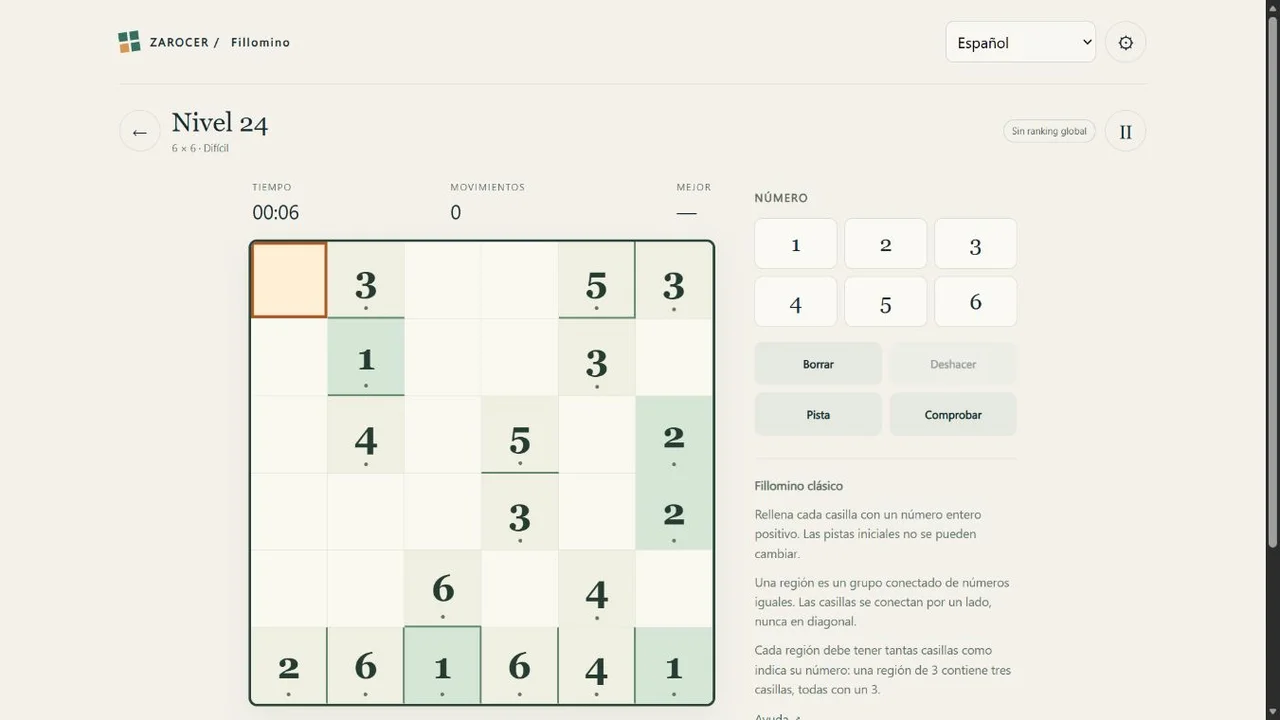
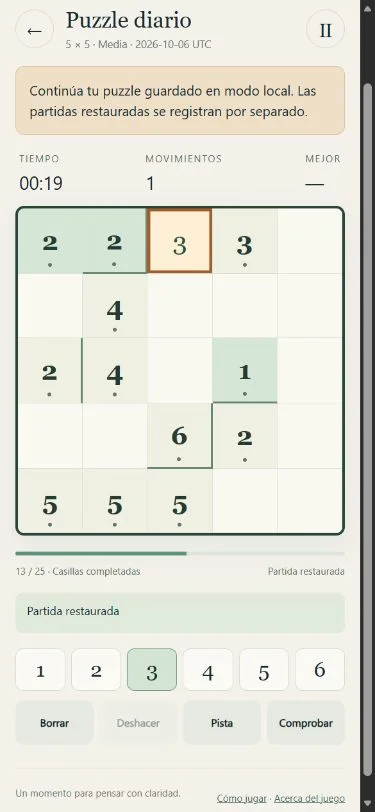
Read numbers as region sizes
Every completed region consists of equal numbers connected through shared sides, and its area equals that number. A region labelled four contains four cells, all marked four. A one is a single cell. Equal values joined by an edge form one region whether you intended them to or not; you cannot declare a separate boundary between them.
Diagonal contact does not join regions. Two completed twos may meet at a corner, but they cannot share a side because their combined four cells would form an oversized region of twos. The same principle applies to larger sizes. Identify connected groups rather than counting equal numbers anywhere on the board.
Starting clues are fixed. A region can contain multiple matching clues, and a region can also contain no initial clue. These details distinguish Fillomino from Nurikabe's one-clue islands. Do not begin by assuming that every printed number must own an independent region or that all regions need a printed founder.
Close groups that already have their full area
A given one is complete and its side neighbours cannot be one. Two adjacent given twos already form a complete group of two, so any neighbouring empty square must take a different value. Three connected threes provide the same kind of boundary exclusion. These are straightforward opening deductions when the clues happen to supply them.
An exclusion does not determine the neighbour's eventual number. A cell beside a completed two may become three or another valid size. Record the prohibition or remember its boundary, but do not turn it into a guessed value merely to make the picture look finished.
After any new entry, recount the region it touches. A value that looked legal on its own might connect two matching groups through the new cell. That changes the total area instantly. Boundaries are a central part of the reasoning even when the interface presents them through colours rather than drawn lines.
Measure available growth
Suppose a region of five currently has four confirmed cells and only one available neighbouring square. If that is genuinely its last expansion route, the fifth cell is forced. Completing the group then excludes fives around its entire side boundary, which may reduce the options for other regions.
A fixed clue with a different value cannot be absorbed into the group. An existing three blocks a region of fives just as surely as a decided boundary would. Empty space beyond that clue is not reachable through it, so do not count the distant cells as available growth without finding another route.
When several routes remain, compare their effects instead of assuming the shortest one wins. A region can bend, and its area rather than compactness is the rule. A useful rejection needs evidence: an oversized equal-value component, an unfinished component with no exit, or an immutable clue that cannot be satisfied. An unattractive shape alone is not a contradiction.
A bridge between equal clues
Imagine two given fours separated horizontally by one empty cell. Filling that middle cell with four joins both clues and supplies three cells of a potential four-region. The combined group still needs one additional cell. This can be legal, but the original clues might also belong to separate regions, so the bridge is not automatically forced.
Now add a confirmed four directly below each clue. The bridge would connect five cells: the two clues, the two lower cells and the middle square. That exceeds the region size, so the middle square cannot be four under those assumptions. The same empty square changes from a candidate to a rejected bridge because of the component sizes.
Compare two fours that touch only diagonally. They are not connected yet. Each may grow separately or later join through a route whose final area is exactly four. This example highlights three distinct observations: equal values, geometric proximity and side connectivity. Only the third decides which cells you must count together.
Allow regions without printed clues
Classic Fillomino does not require every region to contain a starting number. A leftover area can form its own valid group if its size, values and surrounding boundaries work. It can also introduce a region size absent from the printed clues, provided the current interface supports the required entry.
That flexibility is not a shortcut for filling every inconvenient pocket with its area. A four-cell pocket marked four must not share a side with another four-region. Its creation must also leave neighbouring clues enough space to reach their own sizes. Check those conditions before treating the proposed pocket as settled.
Knowing the rule prevents a different mistake: declaring a square impossible because no existing clue can claim it. Investigate whether it could belong to a new region. Keep that as a candidate until the surrounding constraints decide it, rather than forcing every square into the nearest printed number.
What local checking can tell you
The published game follows classic rules and keeps initial clues immutable. Select an empty cell, then use the number panel or keyboard. Arrow keys navigate, Delete or Backspace erases, Control-Z undoes and Escape pauses. Read the visible controls for values beyond a single digit rather than assuming another site's interface applies here.
The journey begins with small boards, Practice offers difficulty choices and Daily uses a finite original collection transformed by rotations and reflections for each UTC day. There is no forced time limit. Progress is stored locally when browser storage is available, with assisted and restored attempts distinguished from fresh play. Global ranking is not available in this release.
A local check can identify a component that is too large or a closed component that is too small. An incomplete region with open neighbours may still pass that check without possessing a full winning continuation. Treat feedback as a rule check, not an assurance that every surviving candidate has been globally solved for you.
Audit by connected components
At the finish, select each unvisited region and follow its equal-number cells through shared sides. Count them and compare the area with the value. Then move to the next unvisited component. This method catches accidental joins that a row-by-row scan can overlook, especially when two same-sized regions meet through one recent entry.
For an oversized group, find the square that bridged previously separate components. For a small closed group, find the decision that removed its final growth route. Those targeted questions are more useful than clearing every number of the same value from the board.
On your next small puzzle, practise spotting one completed region, one forced extension and one forbidden bridge. The game links below lead to the current Fillomino build. Nurikabe and Symmetric Galaxies offer different partitioning challenges, but their one-clue islands and rotational centres change the rules substantially. Understanding those differences helps you choose a fresh puzzle without losing the component reasoning you just learned.
Keep playing
Every game page lists its current version and controls and offers a fullscreen play view.
Explore the collection: Logic Puzzle Games