
Slant puzzle strategy: count endpoints and recognise a forbidden loop
Slant, presented here as Diagonals, puts one sloping line in every square. The clues live at the grid's points and count how many lines meet them. A second rule changes the solving process: no connected group of lines may close a loop. This guide combines local endpoint counts with a global connection check, and explains why disconnected open paths are allowed.
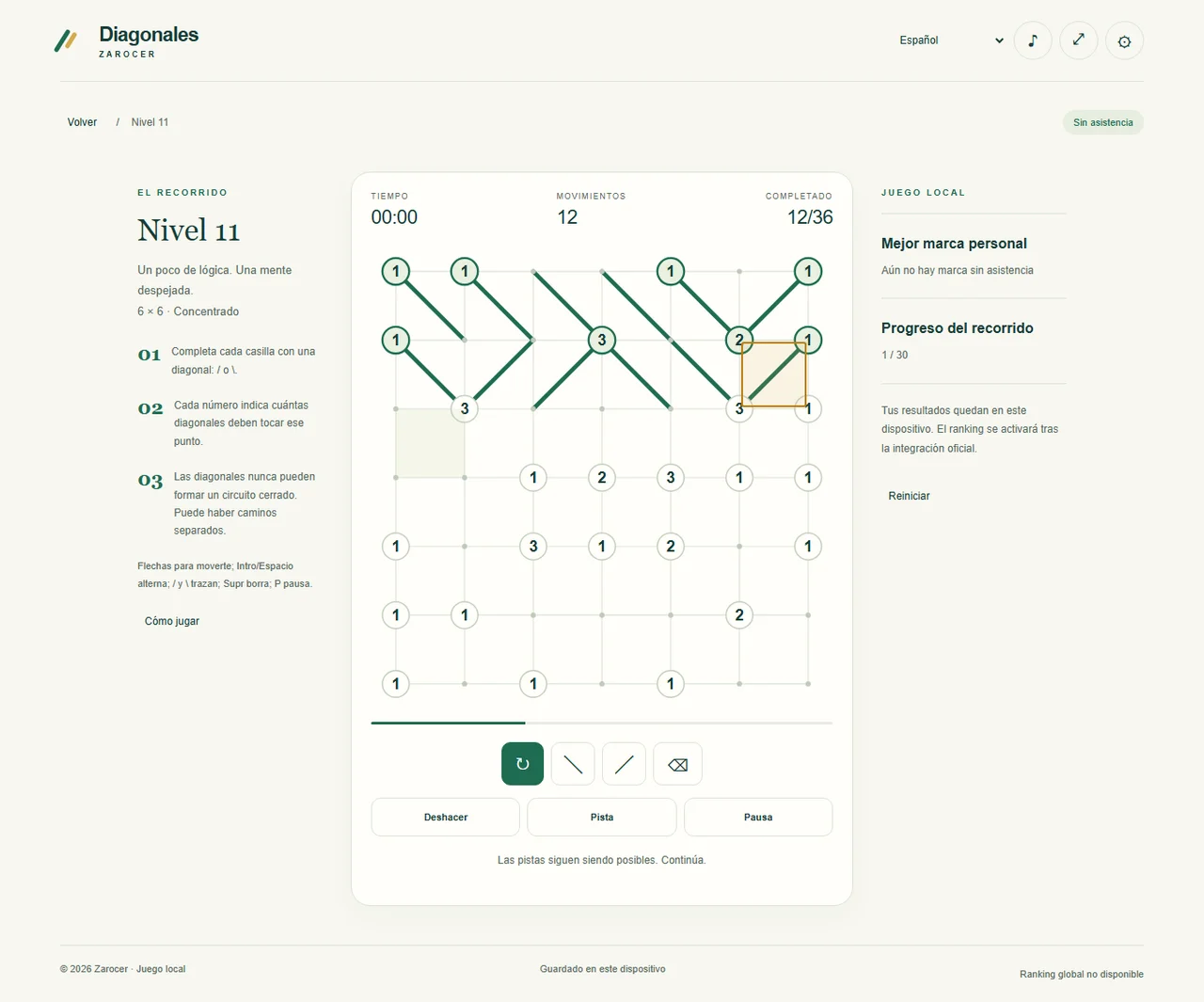
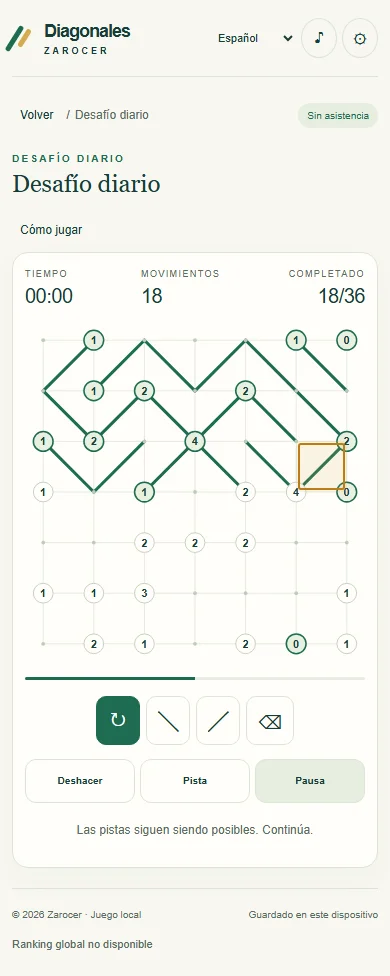
Read the point instead of the square
Each square receives one of two diagonals, joining one pair of opposite corners. The line supplies one endpoint to each of those two points and none to the other two. A number at a point specifies how many neighbouring diagonals must terminate there. It is not a value to enter inside the nearest square.
An interior point can receive lines from four surrounding squares. An edge point has fewer options and a corner has only one. Count the actual neighbouring squares before interpreting the clue. Two can be a complete requirement at an edge but a flexible intermediate requirement in the middle.
Every square must eventually contain a diagonal. The lines need not form a single path, and branching at a point is not automatically wrong. Separate open networks are allowed. Unlike a loop-building puzzle, Slant asks you to avoid closed circuits rather than find one circuit that visits everything.
Start with exact endpoint quantities
A zero excludes every diagonal orientation that would touch its point. The affected squares are not left blank: each must use its opposite orientation. That makes a zero a source of concrete placements, not simply a reminder to avoid a location.
A clue equal to its number of available neighbouring squares forces all those squares to point toward it. An interior four fixes four diagonals. A two beside a straight board edge can fix its two possible diagonals. Always establish the available options rather than treating a printed number as universally easy or difficult.
Later in the solve, subtract endpoints already supplied. If a three has two incoming lines and one remaining possible neighbour, that neighbour must connect. If the three already has three, all unfinished neighbouring squares must avoid it. This remaining-count rule is the same logic expressed after part of the board is known.
A diagonal affects both ends
Before drawing a line, check the counts at its two endpoints. Also inspect the two corners it avoids, because the alternative that would have served them is disappearing. A line can satisfy one nearby clue while leaving another with insufficient remaining opportunities.
Suppose a one already has an incoming line and an adjacent square remains undecided. That square must choose the diagonal that misses the one. The chosen orientation may then supply the final endpoint needed by a different clue. Progress travels through squares between points; the clues cannot be solved as unrelated counters.
If neither orientation appears legal, recount the existing lines carefully. A diagonal reaches only its two selected corners. It does not create an extra connection at the square's centre, and visual proximity to a point is not an endpoint. Misreading that geometry can manufacture a contradiction in an otherwise valid position.
Check whether the endpoints are already connected
A proposed diagonal closes a loop when its two endpoints are already connected by another path of existing diagonals. Follow that path through shared points. It may take a wide route across the board rather than form a small obvious diamond. The rule concerns a closed graph, not just a recognisable tiny shape.
Two lines meeting at one point do not by themselves form a loop. They may create an open bend or a branch. To demonstrate a cycle, you need a route that returns to its starting point without relying on the proposed missing line. The new connection then completes the circuit.
This check can decide a square even when its endpoint clues remain flexible. If one orientation would join points already connected and the other would not, the first is prohibited. The surviving orientation must still pass the number checks. Avoiding a cycle is a necessary condition, not permission to overfill a clue.
A conditional two-clue example
Imagine an interior point labelled three. Two surrounding squares already send lines into it, a third is known to point away and the fourth is undecided. The fourth must connect because it is the only remaining way to supply the third endpoint. Inspect its opposite endpoint next and update that point's count.
Now imagine that this forced diagonal would close an existing path into a loop. The current assumptions cannot all be correct. Revisit the earlier lines responsible for the path or the count, rather than accepting a loop as an exception. The conflict tells you which two families of constraints disagree.
In another position, tracing the apparent path might reveal an open break. Then the proposed line does not close a circuit, and the count-based placement can remain valid. This illustrates why a picture that looks almost circular is insufficient evidence: you must follow actual connections from point to point.
Modes and controls in the published edition
The journey has thirty levels progressing through four-by-four, six-by-six and eight-by-eight boards. Free play lets you select a size and generates a puzzle checked for a unique solution. The shared daily challenge uses a six-by-six grid for each UTC date. Grid size changes the amount of reasoning, not the meaning of an endpoint clue.
Tap a square to cycle its contents or select a drawing tool. Keyboard players can navigate with arrows, use the slash or backslash keys for orientation, and Delete to clear. Read the displayed instructions if your keyboard layout places those characters on different physical keys. The desired diagonal matters more than its familiar key position.
Hints and undo support learning. Assisted and restored attempts are marked as local, and the global ranking is not enabled in this release. Journey progress stays on the device. A portal sign-in should not be treated as a promise that this native board is synchronised to another profile or machine.
Review the final grid in three passes
First make sure every square contains exactly one diagonal. Then count endpoints at each numbered point. Finally trace connected networks and look for a return to a starting point. A full board can satisfy every printed number and still contain a prohibited loop, so the connection pass cannot be replaced by checking the counters.
For a wrong number, inspect its neighbouring squares rather than changing a distant line at random. For a loop, identify which recent orientation completed the connection. A targeted revision preserves other deductions and reveals whether the mistake was a counting error or an unsupported assumption about a path.
For the next session, aim to explain one placement from an exact remaining count and another from the no-loop rule. After a hint, determine which reasoning could have produced its orientation. Use the links below to open Diagonals and its current controls. Nurikabe and Fillomino also involve connectivity, but their water and region rules do not count diagonal endpoints. Comparing those differences helps you keep a useful technique without importing an incompatible objective.
Keep playing
Every game page lists its current version and controls and offers a fullscreen play view.
Explore the collection: Logic Puzzle Games