
How to play Hitori: rules, shading and connected cells
Hitori asks you to shade selected numbers, but removing duplicates is only part of the puzzle. The light cells left behind must be unique in every row and column, dark cells cannot share an edge, and the light area must remain connected.
Read the three constraints together
A number that stays light cannot appear twice in its row or column. That makes every duplicate a choice, but the choice is never just about which copy is easier to shade. A move must also leave the rest of the grid legal.
Dark cells may meet diagonally, but never through a shared edge. Finally, every light cell must be reachable from every other light cell through up, down, left or right moves. A grid with no visible duplicates can still fail if its light cells have been split into islands.
Use duplicates to create forced light cells
Start with repeated values and inspect their edge neighbours. Once a square is dark, every square next to it by an edge is forced to stay light. That consequence often settles another duplicate in the same row or in a crossing column.
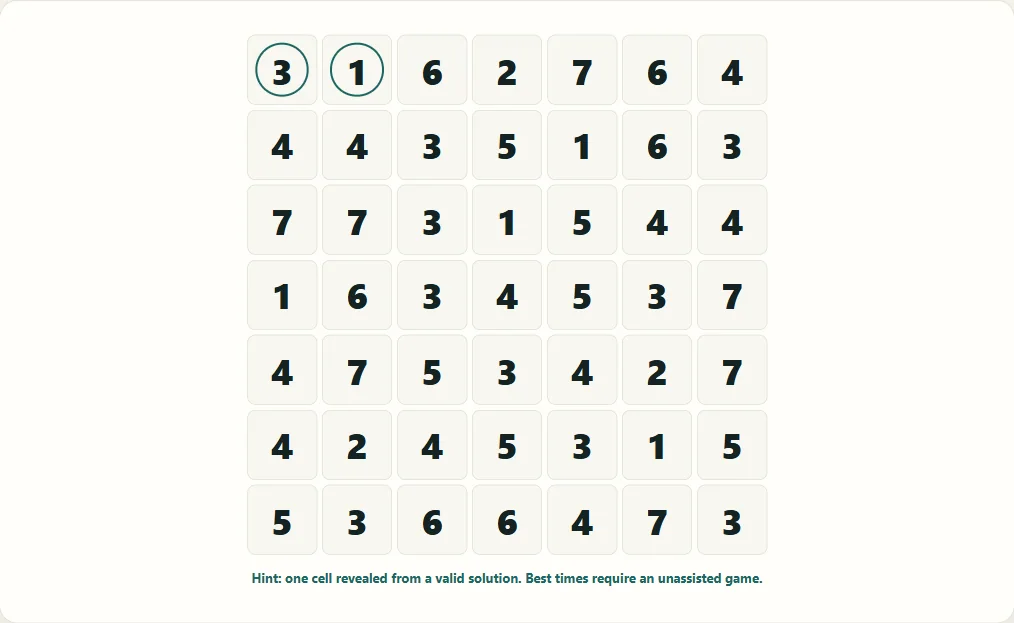
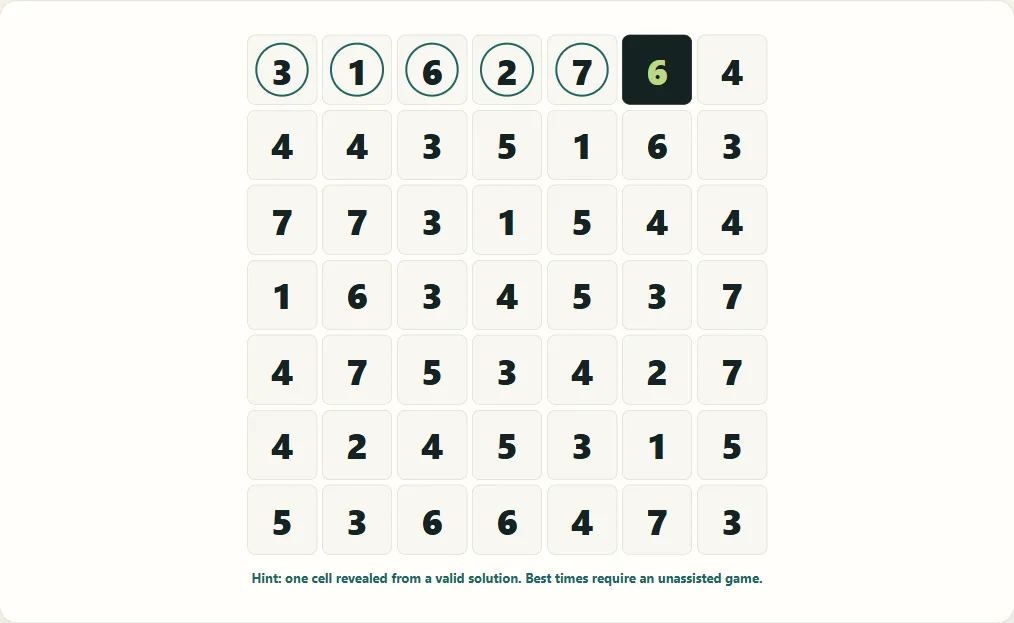
A circle is an optional note, not a fourth game state. Use it when you want to remember that a cell should stay light while you test another deduction. Completion checks uniqueness, dark-cell adjacency and connectivity; it does not require every light cell to be circled.
Keep routes open before they become a problem
Corners and narrow corridors deserve extra attention because they have few escape routes. If two edge neighbours of a light corner are dark, that corner has been isolated. Before shading near a boundary, trace at least one route through light cells back toward the grid.
Do this check while solving rather than saving it for the end. When two local choices both remove a duplicate, the choice that preserves more possible light routes is usually safer to investigate first. Connectivity turns Hitori into a whole-board puzzle, not a collection of independent rows.
Recover from common false solutions
It is easy to satisfy the repeat rule while accidentally creating adjacent dark cells or cutting the light area in two. Use Check to learn which rule is broken, then undo the assumption that caused the conflict. You do not need to discard a board that still contains useful confirmed cells.
Avoid shading a number merely because it looks inconvenient. Ask whether it must disappear to remove a duplicate, and whether the neighbouring and connected light cells can still work. Switching repeatedly between rows and columns gives each certain decision more chances to constrain the next one.
Practise in this Hitori edition
This published Hitori version generates 5×5, 6×6 and 7×7 boards checked for one solution under all three rules. Its daily puzzle uses a 6×6 board tied to the local date. Progress, undo history and statistics stay in the current browser.
Click or tap to cycle a cell between light, dark and circled; right-click toggles a circle. Arrow keys move focus, Enter or Space changes the focused cell, Z undoes, H reveals a correct cell and C checks the board. A hint assists the current run, so newly assisted games do not set a best time.
Keep playing
Every game page lists its current version and controls and offers a fullscreen play view.
Explore the collection: Logic Puzzle Games