
Futoshiki vs Sudoku: what changes beyond the grid?
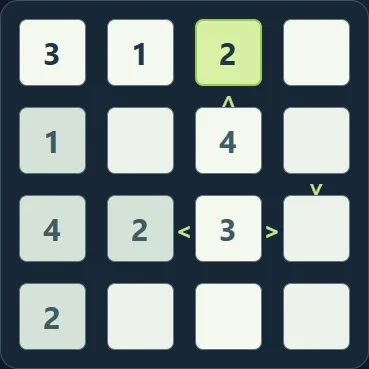
Futoshiki can look like a smaller Sudoku, but its clues change the reasoning. Both prevent repeated numbers in rows and columns. Sudoku also uses boxes; Futoshiki uses relationships between neighbouring cells.
What a Sudoku player already knows
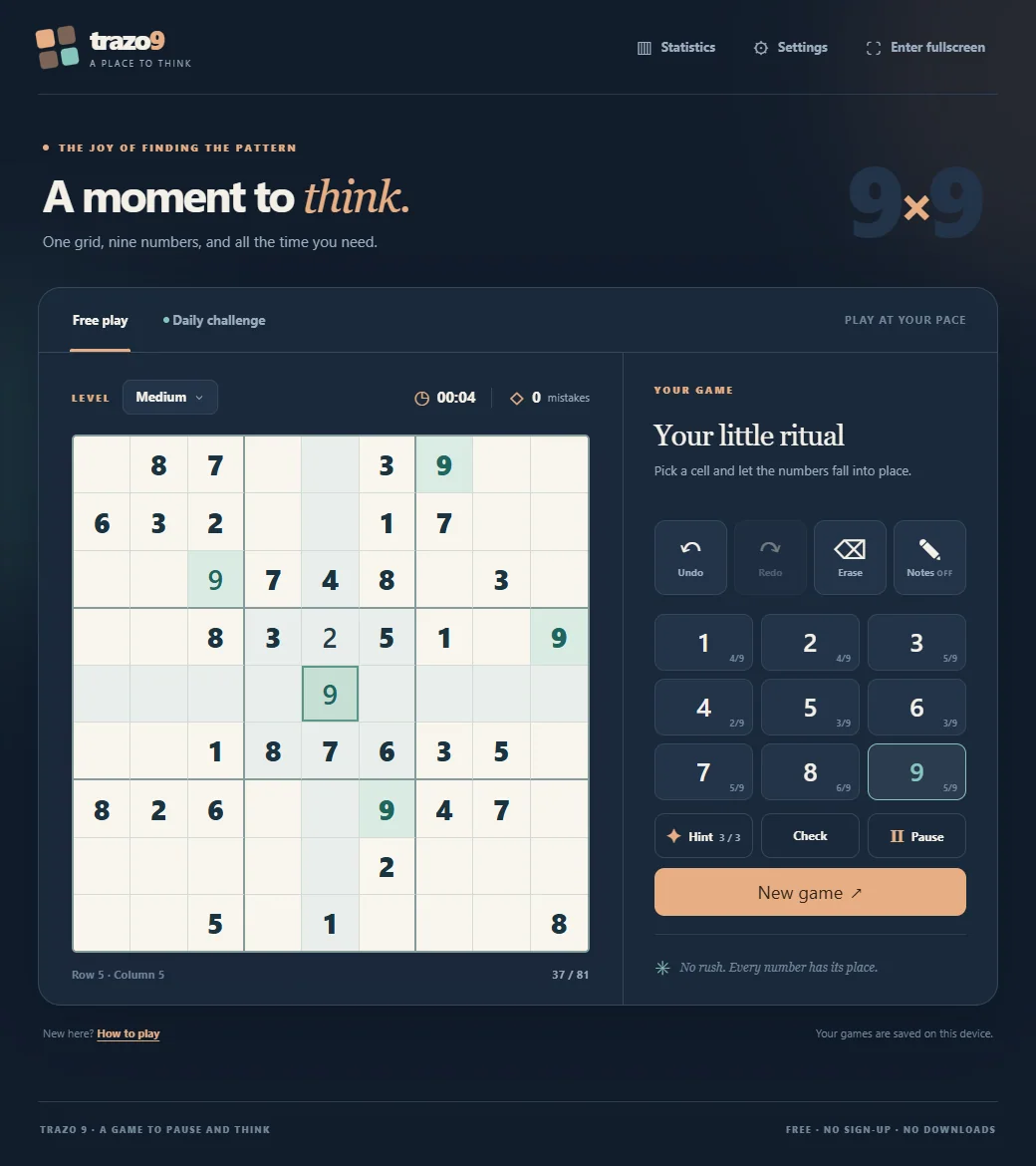
Both puzzles use fixed starting clues and exclude repeated digits within a row or column. Trazo 9 uses 1–9 on a 9×9 grid. A 4×4 Futoshiki uses 1–4, with the range growing when the grid grows.
Pencil notes transfer well: write the remaining candidates after checking the row and column. Then apply the rule that makes this puzzle different. Notes record possibilities, not permission to ignore a clue.
Replace boxes with inequality clues
Sudoku's 3×3 boxes connect cells that might not share a row or column. Futoshiki has no boxes, so excluding a number because of an imagined box would be a mistake. Instead, < and > compare the two cells beside the sign.
The point faces the smaller value, and the open side faces the larger one. The values need not be consecutive: 1 < 4 is as valid as 1 < 2 on a 4×4 grid. A sign supplies an ordering constraint rather than an exact difference.
Why a chain helps before you know its numbers
Consider A < B < C in a 4×4 puzzle. A cannot be 3 or 4 because two larger values must fit after it. C cannot be 1 or 2. That is a useful deduction even when no cell has a single candidate yet.
Sudoku does not assign an ordering to a row merely because its cells sit next to one another. It relies on existing digits and shared regions. In either puzzle, an elimination should send you back to the crossing row or column to see what else changed.
Choosing a browser edition
Try Futoshiki for inequality chains on 4×4, 5×5 or 6×6 grids, with three difficulties, notes, hints and a daily challenge. Choose Trazo 9 for a 9×9 Sudoku with four difficulties, notes, limited hints, checks and undo.
Smaller does not automatically mean easier: the placement of clues controls the work. Both editions keep progress in the current browser. Their game pages carry the current controls and version; choose the constraint you enjoy rather than assuming one puzzle must be a stepping stone to the other.
Keep playing
Every game page lists its current version and controls and offers a fullscreen play view.
Explore the collection: Logic Puzzle Games