
How to play Futoshiki: inequalities and first deductions
Futoshiki combines a no-repeat number grid with greater-than and less-than signs. Each clue limits only two neighbouring cells, yet those limits cross with the whole row and column.
The rules: a grid with no repeats
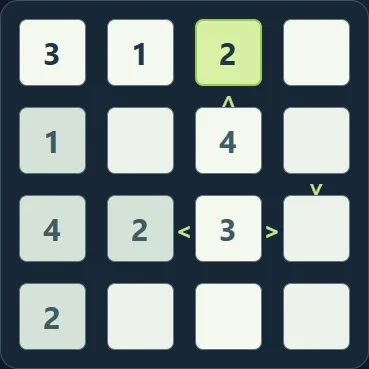
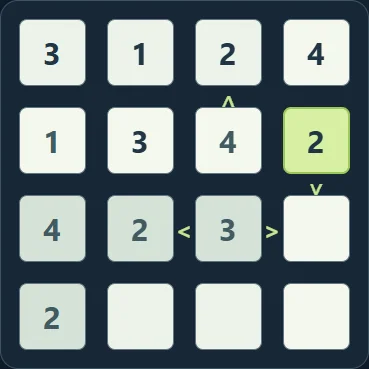
On an N×N grid, use the numbers from 1 through N. Every row contains each number once and every column does too; unlike Sudoku, there are no 3×3 boxes.
Starting numbers are fixed parts of the solution. An empty cell must work with the numbers already in its row and column as well as with any sign that joins it to a neighbour.
How to read an inequality sign
A < sign means the cell on its left holds a smaller number than the cell on its right; > reverses that relationship. The point of the sign faces the smaller number and its open side faces the larger one.
The sign does not require consecutive values. On a 4×4 grid, 1 < 4 is valid even though two values sit between them. It relates only the two cells it touches, but that relation removes candidates across their rows and columns.
Start with extremes and chains
The smallest value cannot sit on the larger side of a sign, and the largest value cannot sit on the smaller side. That observation can turn a cell into a certain decision before you need a longer calculation.
Then look for chains. If four cells must rise from left to right through three relations, they can only be 1, 2, 3 and 4 in that order. A partial chain also sets bounds: a cell with two upward steps ahead cannot be one of the highest values.
Cross inequalities with rows and columns
Do not solve each sign in isolation. When a row already contains several numbers, remove them from its empty cells and inspect its relations again. An inequality that once allowed two candidates can become forced by its crossing column.
Use notes when a cell keeps more than one possibility. They are not guesses: they keep compatible options visible while a new number or sign chain eliminates one. Remove an option as soon as it repeats a number or breaks a relation.
Practise in the published version
The portal’s Futoshiki edition has 4×4, 5×5 and 6×6 grids, three difficulty levels, notes, hints and a daily challenge. The current game and local progress can continue in the same browser when storage is available.
Click or tap a cell to enter a number, then use the build controls to undo or restart. Begin on a smaller grid: the aim is to check every inequality alongside its row and column, not to fill digits quickly.
Keep playing
Every game page lists its current version and controls and offers a fullscreen play view.
Explore the collection: Logic Puzzle Games