
Skyscrapers puzzle strategy: turn edge clues into useful candidates
Skyscrapers asks a different question from Sudoku: how many buildings can you see from the end of a street? Every cell holds a height, and taller buildings hide smaller ones behind them. The challenge is to reconcile several views of the same grid. This guide starts with four-building examples, then shows how those observations support notes, error checking and deliberate play in the available browser edition.
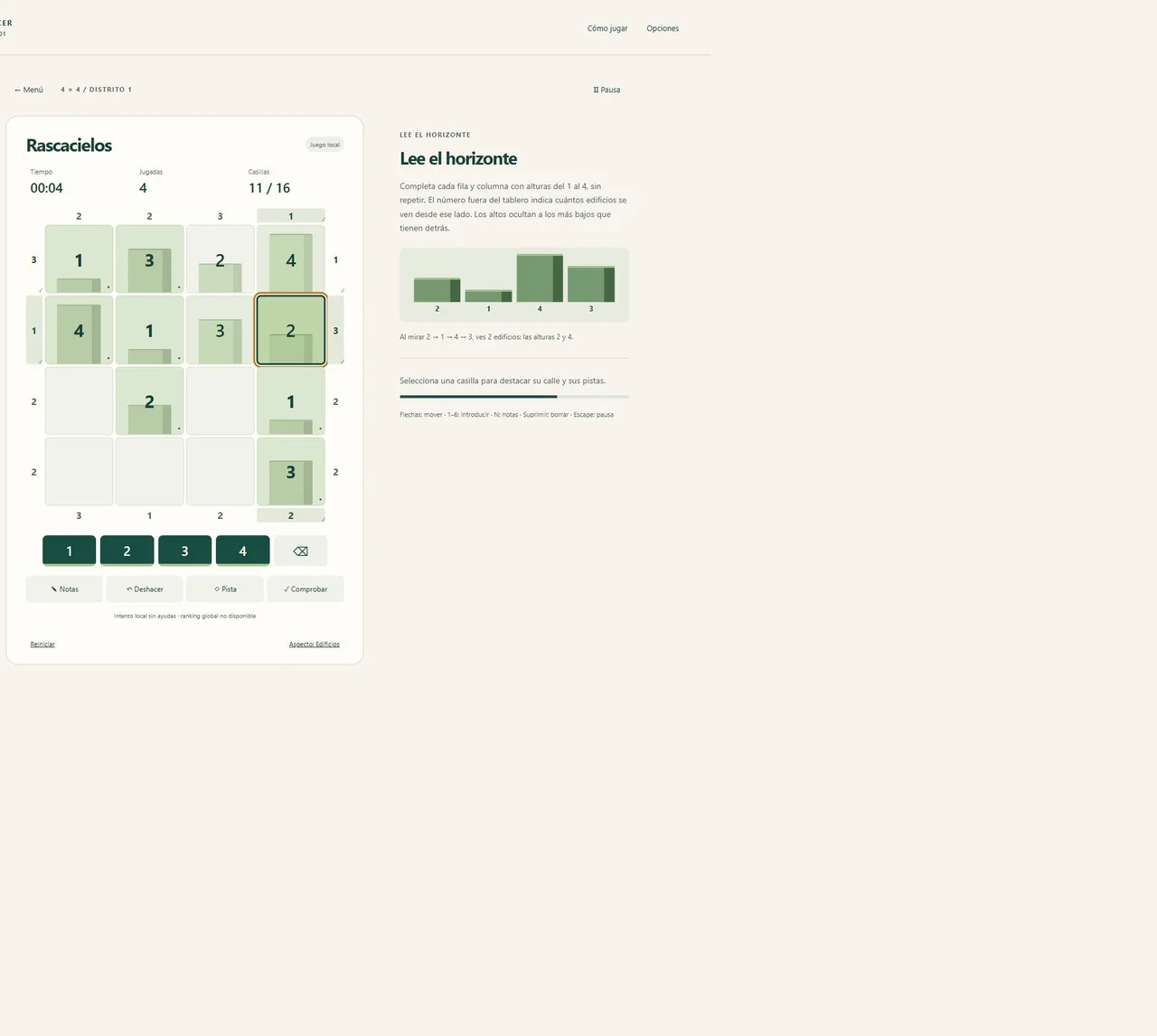
Count new maximum heights
On a four-by-four board, each row and column uses one, two, three and four exactly once. There are no Sudoku boxes to fill. An edge clue counts visible buildings when looking into its row or column from that edge. Start with no height seen, scan the line and increase the count whenever the next height exceeds every earlier one.
Consider three, one, four, two. From the left, three is visible, one is hidden, four is visible and two is hidden: the clue is two. From the right, two appears first, followed by four; one and three are then hidden. The opposite clue is also two. Equal clues do not mean that the street itself is symmetrical.
Now compare one, two, four, three. The left view shows one, two and four, while the right view shows three and four. This street needs clues three and two. None of these counts is a sum of heights. Keeping an explicit running maximum is a reliable way to avoid counting a building that is technically present but hidden.
Use the extremes as an opening
A clue of one forces the tallest height into the first square from that side. If a smaller building stood first, the tallest building somewhere behind it would create a second visible building. On a six-by-six board the required first height is six, not four; always read the board size before applying a familiar pattern.
A clue equal to the grid size forces the entire line into ascending order from that edge. On a four-cell line, seeing all four requires one, two, three, four. Put three before two and the two disappears behind it. A maximal clue therefore gives a complete sequence, whereas a clue of one usually fixes only the first square.
Once you place these forced values, remove their heights from other cells in the crossing columns. A column with only one position remaining for a height gives another placement even if neither of its edge clues is extreme. The opening clues are useful because they feed the Latin-square constraints, not because every board can be solved by finding more ones.
Intermediate clues leave several arrangements
Do not write a two into the first square simply because its edge clue is two. The line two, four, three, one fits that left clue, but so does one, four, two, three. The clue specifies a visible count, not the first building's height. Compare actual candidate sequences instead of matching printed numbers to empty squares.
A four-cell line with a left clue of three cannot start with three or four. Starting with four shows one building; starting with three can reveal only the later four in addition. That leaves one or two as candidates for the first position. This is a useful restriction, but not yet a solved square.
When the tallest building is placed, divide your reasoning at that point. Everything after it is hidden from the current edge. The buildings before it determine how many earlier increases are possible. From the opposite edge, the same tallest building plays the same blocking role with a different prefix. Combining those two views can eliminate arrangements that one clue alone accepts.
A worked candidate test
Imagine a four-cell street with clues two from the left and three from the right. Suppose the first cell is three. The remaining heights are one, two and four. To show three buildings from the right, the scan must encounter two increasing shorter heights before reaching four. One valid sequence is three, four, two, one: from the right you see one, then two, then four.
Check the left view of that sequence. Three is visible, four is a new maximum and the final two and one are hidden. It matches the left clue of two. This proves that three is possible at the first position, not that the entire row belongs in your real puzzle. Each of its values must still fit the corresponding column.
Compare three, two, one, four. It also shows two from the left, but the right view starts with four and therefore shows only one. The right clue rejects it immediately. Keeping both sequences on paper makes the reason for the rejection clear: no mysterious advanced technique is needed. You are testing the same visibility rule in both directions.
Notes should record surviving possibilities
If a square could still contain one or two, record those alternatives rather than committing because one makes a nearby row look tidier. A candidate is justified by the current row, column and clue restrictions. As new values appear, revisit the notes that depended on them. Stale notes can make a perfectly solvable position appear to have no options.
In the available edition, Notes stores possible heights, while Check highlights repeated values and completed lines that disagree with their edge clues. A partially filled row may have no reported conflict and still lead to a dead end. The checker is not a statement that every unfilled candidate belongs to some full solution.
Use a hint after identifying what you are missing: an opposite view, a column exclusion or a candidate permutation. The hint reveals one correct height. Explain how that height changes the other possibilities before requesting another. This converts assistance into a useful observation instead of a sequence of unexplained answers.
Choose a board that fits your practice
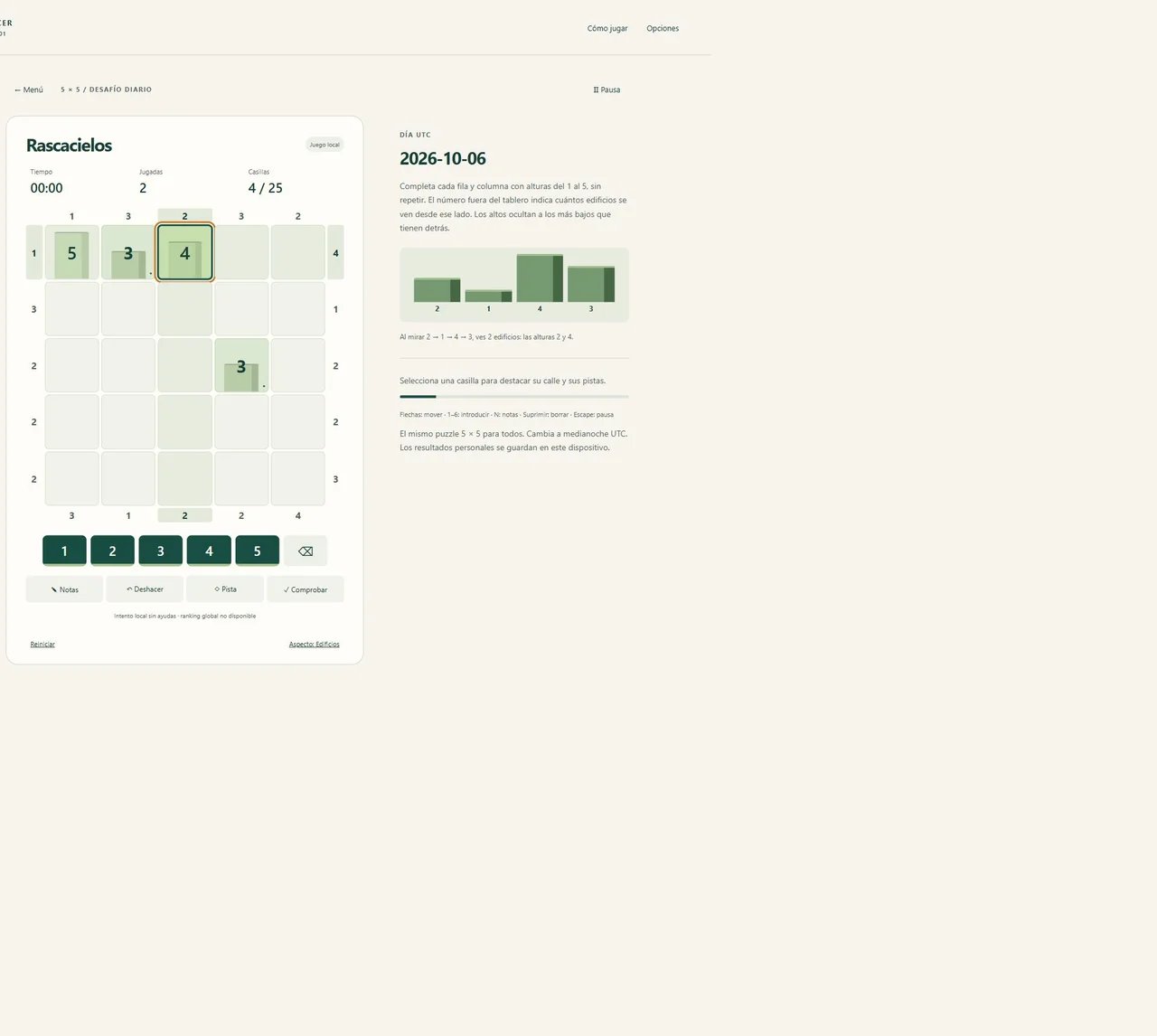
This version includes eighteen journey districts progressing through four-by-four, five-by-five and six-by-six grids. Free play generates a board at the selected size. The shared daily challenge uses a five-by-five board and renews at midnight UTC. Bigger streets add more possible permutations, so moving up a size is a different exercise from merely repeating a small board faster.
Select a square, then choose a height using the visible controls or keyboard. Notes and Erase help revise a position. Your city and preferences are saved on this device, and assisted results remain local. There is no active global ranking in this release. Do not treat a portal account as a promise that the native puzzle state has been copied to another browser.
For a useful next session, calculate the two clues of several four-height arrangements before playing. Then choose a small district and look for one forced value that crosses a solved street. Open the Skyscrapers game page through the links below for the current controls and build. Futoshiki and Killer Sudoku offer related candidate reasoning, but their inequalities and cage totals demand different checks from a street's visible buildings.
Keep playing
Every game page lists its current version and controls and offers a fullscreen play view.
Explore the collection: Logic Puzzle Games