
One-star Star Battle strategy: use candidates before choosing a square
Star Battle can give you useful deductions before you know the location of a single star. A region restricted to one row reserves that row; two possible placements may exclude neighbouring squares in common. Estrellas uses the one-star variant, so these ideas are particularly approachable. This guide focuses on candidate reasoning, practical examples and the actual tools available in the browser build.
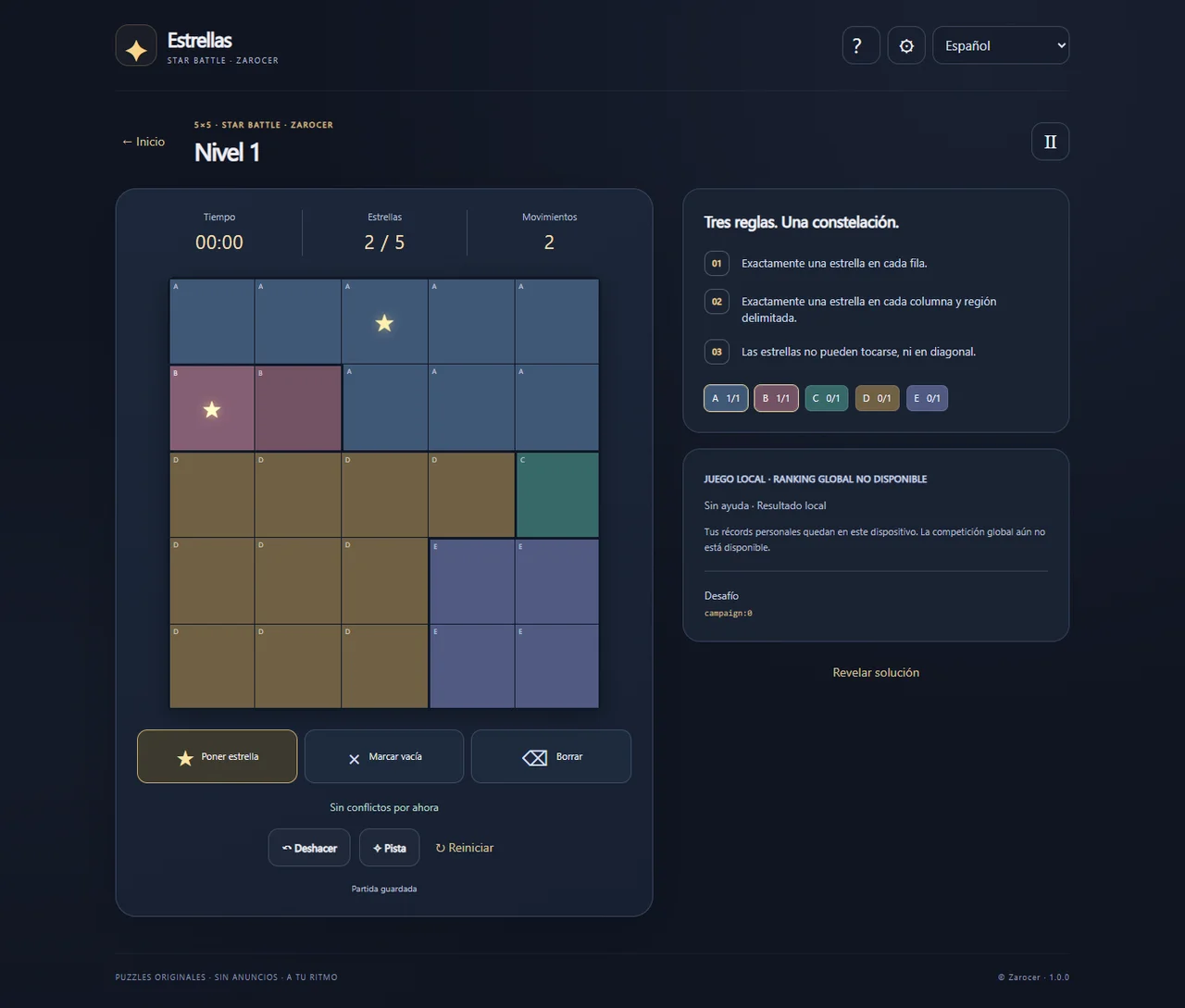
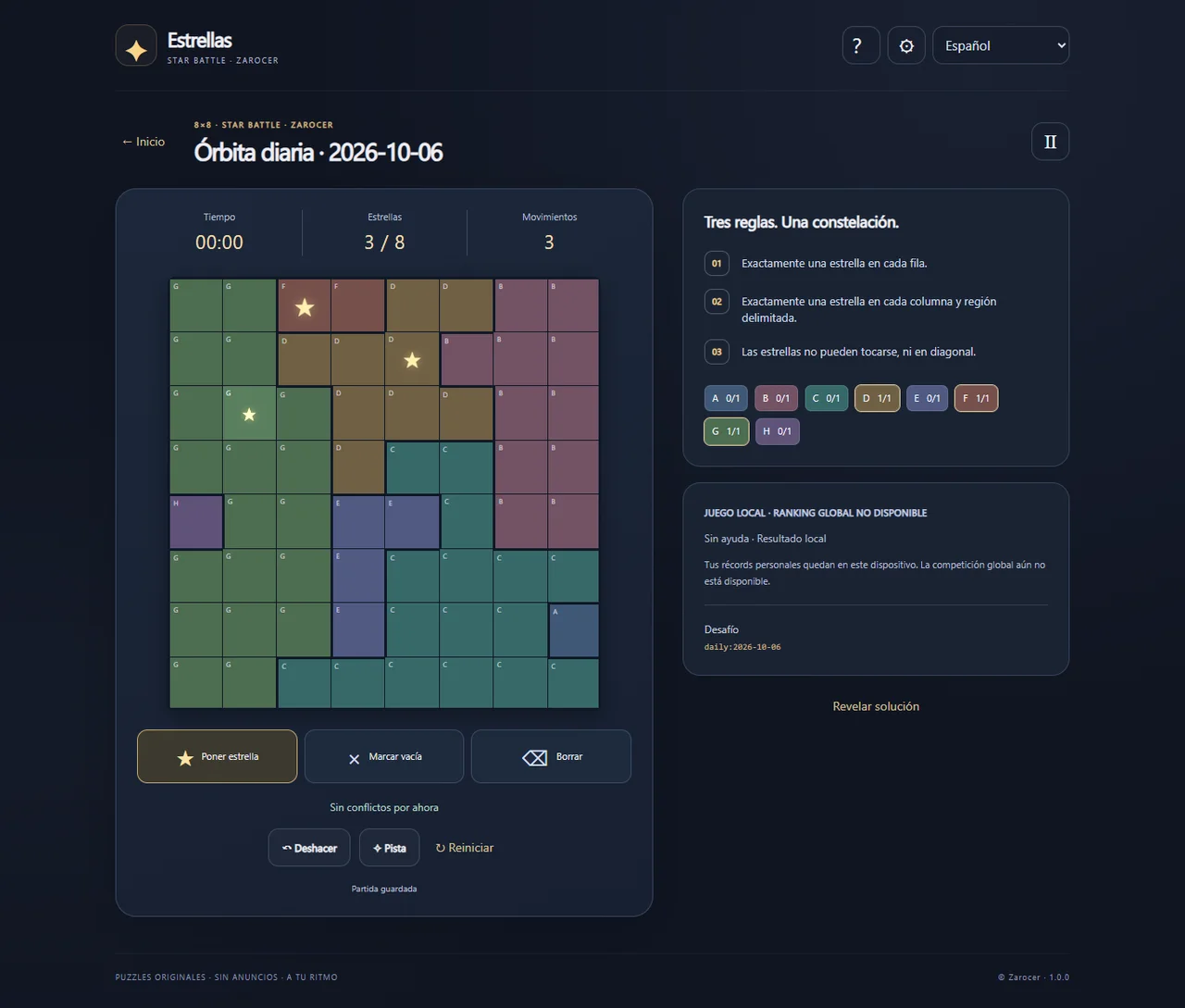
Check the variant before counting
Every row, column and outlined region needs exactly one star in this edition. Stars cannot touch through a side or corner. A placed star therefore satisfies three quotas at once and excludes nearby squares. Some other Star Battle puzzles ask for two stars per group; techniques must respect the actual quota, so do not import their counts into this one-star game.
Regions may have irregular outlines. They are not Sudoku boxes and do not need equal areas. A larger region still receives one star. Diagonal separation means immediate corner neighbours are forbidden, not that every pair of stars anywhere along the same diagonal is illegal.
An eight-row board ends with eight stars. Those same eight must also satisfy the eight columns and the regions. You do not place a separate set for each family. This explains why a solution that looks complete region by region can fail: two of those stars may occupy the same column.
A confirmed star has several consequences
Once you know a square contains a star, exclude the rest of its row, column and region. Then exclude its eight surrounding neighbours wherever they exist. Some exclusions overlap. Look for the ones that do not, especially diagonal neighbours in a different region: they can remove a region's final alternative.
Empty marks record rejected placements. They help distinguish a examined square from an untouched one, but decorating every empty square is not the central objective. The required star arrangement matters. If automatic exclusions are enabled, identify what the tool marked because of your placement rather than assuming you personally derived every mark.
Do not mark a square empty simply because another candidate seems better. Two candidates can remain unresolved while you solve another part of the board. Keeping a genuine uncertainty is more valuable than committing to a visually balanced star that lacks a logical justification.
Reserve a row without fixing a star
If all remaining candidates of a region lie in one row, that row's star belongs to the region. All candidates outside the region in the same row can be excluded. You still need to choose which square inside the region receives the star, but the row has already become unavailable to everyone else.
The same reasoning applies to a column. A region spanning several columns might nevertheless have its viable candidates confined to just one after earlier exclusions. Inspect candidates, not the original region's bounding box. Its shape alone does not tell you which resources remain available.
Before making a reservation, trace the entire region outline and check every unexcluded square. A narrow extension can hide one candidate outside the supposedly reserved row. If such a candidate exists, the conclusion is not forced. Reservations are powerful precisely because their premise includes all alternatives.
Two candidates can share an exclusion
Use coordinates for a small thought experiment. A region has exactly two possible stars, D4 and D5. Whichever is chosen, row D is occupied, so its other squares are excluded. Now inspect C4 and C5 above them. Each touches both possible placements: one through a side and the other through a corner. Neither can contain a star.
The same is true of E4 and E5 below. However, C3 only touches D4, not D5. It cannot be excluded solely from this pair. A common error is drawing the whole combined neighbourhood around two candidates and rejecting all of it. You may reject only squares affected by every surviving alternative.
After those shared exclusions, another region might have one candidate left. Its confirmed star could fill column four or eliminate D4 through proximity, leaving D5 forced. The initial pair then becomes a solved location through information from elsewhere. This sequence shows why you need not guess just because a region currently has two choices.
Match groups of regions to lines
Suppose two different regions have all their candidates contained within rows A and B. Both regions require a star, and each of those rows permits one. Together the regions reserve both rows. Other regions cannot place stars there, even though you do not yet know which original region uses A and which uses B.
This argument fails if one region has a candidate in row C, or if you accidentally treated two disconnected-looking pieces of the same region as separate groups. Count identities and requirements carefully. The useful pattern is a fixed number of independent stars restricted to the same number of available lines.
Spacing constraints still apply within the reserved lines. Two stars in different rows and columns can touch diagonally and therefore be illegal. A resource count narrows the choices; it does not certify every arrangement inside the reserved area. Check the geometry again when an exact placement becomes available.
Use the published tools deliberately
Estrellas includes twenty-four original journey levels, a guided tutorial and board-size choices for free play. The journey progresses from five-by-five to eight-by-eight. Daily Orbit offers a shared eight-by-eight puzzle for each UTC date. The bank can appear again in another orientation, so repeated structures are not evidence of an unlimited newly generated daily service.
Mouse, touch and keyboard controls are available. Optional automatic exclusion marks assist bookkeeping. Hints can reveal a correct star, undo can revise a placement, and revealing the full solution ends the current attempt. Read the selected tool and visible instructions before repeated clicks; a placement and an empty mark have different meanings.
The game stores progress, personal records and settings locally when browser storage is available. Assisted and restored attempts are distinguished from fresh unassisted ones. The global leaderboard is inactive in this release. Completing a puzzle with assistance is useful practice, but is not the same record as a newly completed independent attempt.
Audit the finished board in separate passes
Count every row first, then every column, then every region. Finally check surrounding squares for touching stars. Splitting the audit into passes prevents a correct region count from distracting you from an incorrect column. No rule requires a star to sit in the geometric centre of its region.
When a region loses all candidates, return to the last reservation or common-neighbour argument. Did it really cover every alternative? Did you exclude a square touched by only one of two possible stars? These questions locate unsupported assumptions without discarding all earlier valid placements.
In your next small board, aim to find one row reservation and one exclusion shared by multiple candidates before requesting help. The linked game page supplies the current build and controls. Tents and Trees uses similar non-touching placements but introduces tree matching; Symmetric Galaxies centres regions on rotational points instead. Understanding those differences makes the next puzzle choice more interesting and avoids carrying the wrong quota into a new game.
Keep playing
Every game page lists its current version and controls and offers a fullscreen play view.
Explore the collection: Logic Puzzle Games