
Dominosa strategy: track domino types as well as empty cells
Dominosa is a hidden-domino puzzle, not a game of matching the open ends of a tabletop chain. The numbers stay fixed while you recover which neighbouring cells form each domino. Covering the grid is only half the task: every unordered number pair must be used exactly once. This guide develops a solving method that keeps both the inventory and the remaining geometry in view.
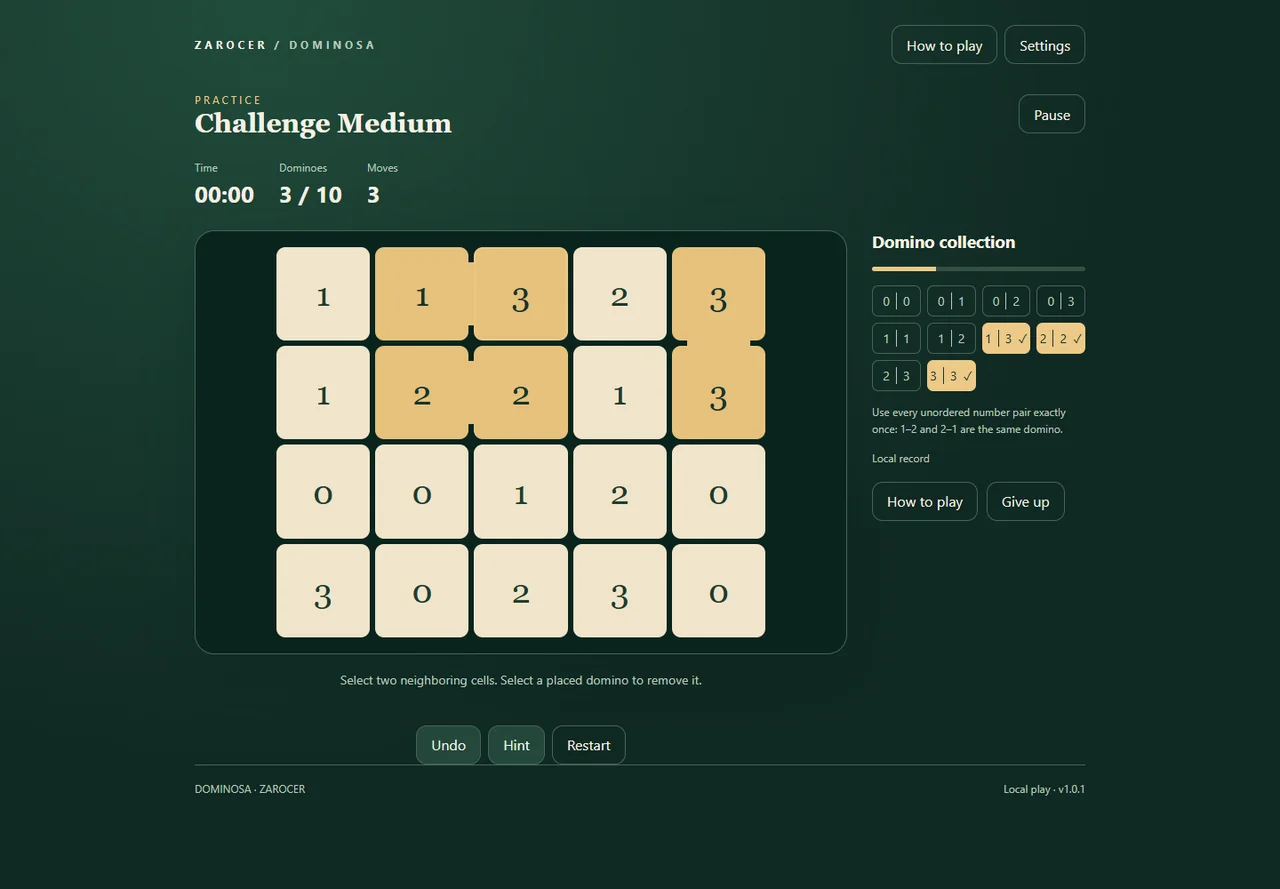
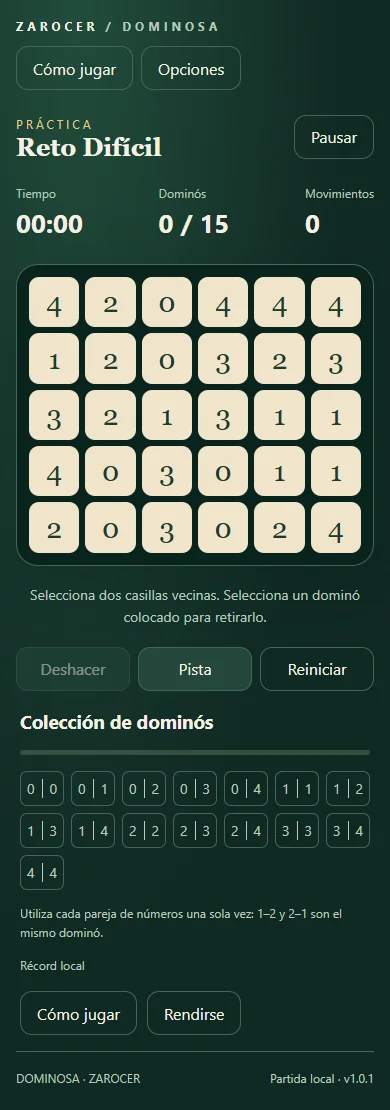
Understand what a domino uses
A domino occupies two side-adjacent cells, horizontally or vertically. Diagonal cells cannot form a piece. Every cell must belong to one domino and cannot be reused. A pair such as one-three is the same type as three-one; reversing its orientation does not create an extra piece for the inventory.
For a set using zero, one and two, the available types are zero-zero, zero-one, zero-two, one-one, one-two and two-two. A completed covering must contain all six once. Repeating zero-one while omitting one-two is wrong even if every square has a partner. Using every type is also insufficient if two pieces overlap.
This creates two complementary questions for each decision: which type have I consumed, and which pairings remain possible around these cells? Keeping a small list of unused types can be more informative than staring at the grid alone. You are reconstructing a complete set, not merely making locally compatible rectangles.
Find types with a unique location
Pick an unused type and examine every horizontal and vertical adjacency that could supply it. If exactly one legal location remains, that domino is forced. Check the whole board before claiming uniqueness. An overlooked vertical pair can invalidate a deduction that seemed obvious while scanning rows.
Once the forced domino is placed, both cells disappear from every competing pairing. That can turn a previously flexible type into another unique location. Recount after meaningful changes rather than making a complete inventory once and assuming its candidate counts stay current throughout the solve.
A type already used cannot be used again. Other adjacent occurrences of its two numbers are therefore forbidden as pairings, but their cells remain available for different pieces. Distinguish rejecting an edge between two cells from rejecting either cell entirely. Dominosa decisions live on those possible joins.
Check cells with only one possible partner
A corner has at most two neighbours; an occupied neighbour or a used pair type can reduce that to one. An interior cell can also become forced after surrounding placements. If a free cell has only one legal partner, those two cells must form a domino, provided the required type remains unused.
For example, a corner cell valued two may touch a zero to its right and a one below. If zero-two has already been used, the right-hand join is unavailable. The lower join must supply one-two. Before placing it, verify that the lower cell is free and one-two is still in the inventory; otherwise the current position contains a contradiction.
That contradiction can be useful. It tells you that an earlier placement removed every possible partner for this cell. Do not solve the problem by allowing a duplicate type or overlapping a piece. Locate the last assumption responsible for the trapped square and reconsider that assumption.
Use odd regions as a rejection test
Every domino covers two cells, so an isolated free region with an odd cell count cannot be tiled completely. A three-cell pocket is a simple warning. The region must genuinely be isolated: if one of its cells can still join a free cell outside, the apparent pocket count does not settle anything.
An even count is necessary but not sufficient. Four remaining cells could require duplicate types, or a shape could prevent the pairings you need. Parity rejects certain impossible positions; it does not guarantee a solution for every even region. Continue inspecting the individual cell neighbours and unused inventory.
Before placing a domino across a narrow passage, look at the free areas it would separate. If one would become an isolated odd pocket, reject the placement. This is a precise consequence you can explain. It is more useful than choosing a piece because it makes the border look regular or preserves a pleasing visual pattern.
Follow a short chain of deductions
Imagine a corner A containing one, with B containing two to its right and C containing zero below it. Suppose one-two is already used elsewhere. A cannot join B, so A-C must become zero-one. This deduction assumes both A and C are still free and zero-one has not been consumed.
After marking A-C, inspect B again. It may lose its only downward alternative and now have a single free neighbour D. Identify the type B-D before placing it. If D contains zero and zero-two is unused, the pairing may be forced. If the required type has already been used, the chain instead exposes an inconsistency.
Notice that a forced partner is not a licence to ignore the inventory. Geometry and type availability need to agree at every step. The example's value lies in the checking sequence, not in copying its letters onto a different board. On a real puzzle, stop when an assumed value or occupancy differs from the thought experiment.
Playing and revising a placement
In the published edition, select two neighbouring cells to create a horizontal or vertical domino. Remove a pairing when you need to examine another option. Arrow keys navigate, Enter or Space selects, and Escape cancels or pauses depending on the current state. Pause and resume are available for a longer solving session.
Consult the linked game page for the current set size and build-specific options. Tutorials elsewhere may demonstrate a larger standard set, but the same unordered-pair reasoning works in a smaller set. Begin by identifying a single forced type and a single cell with one partner; those observations teach the two halves of the puzzle.
Do not infer active global rankings, multiplayer or cloud synchronisation from a personal result display. This article explains the available board mechanics. Check the current game page's storage information before switching devices or browser profiles. A locally resumable game is not automatically a remotely backed-up account session.
A practical two-pass routine
First scan unused types for unique appearances. Then scan uncovered cells for a unique partner. Repeat after each confirmed domino, because the two passes change one another's candidates. When both stall, test one clearly identified hypothesis and look for an immediate inventory shortage or isolated odd pocket.
At the finish, verify every square is covered once and every type appears once. Check that all joins use shared sides and that no original number was changed. Those simple audits target the actual win conditions; a board covered in neat rectangles can still have a repeated type.
Use the screenshots to recognise occupied pieces and remaining joins, then open the current Dominosa build through the links below. Fillomino and Symmetric Galaxies offer different ways to partition a grid. Their region sizes and rotations can be appealing next challenges, but neither follows Dominosa's unique domino inventory. Choose a new puzzle by its decisions rather than assuming every numbered grid is another version of Sudoku.
Keep playing
Every game page lists its current version and controls and offers a fullscreen play view.
Explore the collection: Logic Puzzle Games