
Nurikabe strategy: balance island growth with connected water
The most useful Nurikabe question is often not where an island should grow, but where the water still needs to pass. Numbered islands and the surrounding sea compete for the same undecided squares. Reading only one side of that relationship can produce a tidy local shape and an impossible final grid. This guide explains a repeatable approach to the published Islands and Sea edition, with conditional examples rather than unexplained solution pictures.
Count the clue square itself
A numbered island contains exactly the number of squares printed in its clue, including the clue's own square. A four therefore needs three additional island squares. Its cells must connect through shared sides, and the island must contain exactly one numbered clue. Touching at a corner is not a connection. Different islands cannot share an edge because that would merge them into one group.
The remaining squares form one edge-connected sea. No two-by-two block may be entirely sea. These two water requirements are separate: a pattern without a black square can still contain disconnected pools. Every unnumbered square eventually becomes island or sea, but an undecided square during play is not yet evidence for either choice.
A clue of one is already a complete island. Its side neighbours are immediately sea, while its diagonal neighbours remain undecided unless another rule fixes them. Starting with these simple boundaries creates reliable information without requiring you to predict the shape of a large island from its first cell.
Grow only where enough room remains
For each unfinished island, subtract its confirmed size from its target. Then examine the cells through which it can expand. If all but one route are blocked, the first square of the remaining route is forced. That does not necessarily decide the rest of the island: after the first forced step, two branches may become available.
Suppose a two-cell island lies at an edge and all but one side neighbour are already water. It must take that last neighbour. The island is then complete, so every remaining side neighbour of both island cells becomes water. Recording those consequences often produces more progress than repeatedly scanning the original clues.
A distant square may be unreachable by an island that has too little space left. Count the shortest possible route, including every new square needed to connect it. A detour around confirmed water can make a geometrically nearby square too expensive. Do not mark a square as sea merely because one island cannot reach it; check the other islands too.
Keep separate clues separate
Two numbered squares with a single undecided square directly between them force that middle square to be sea. Making it island would create a connected group containing both clues. The numbers do not need to match for this restriction to apply. Adding their target sizes together does not create permission for a merged island.
The same idea applies to an undecided square touching two already identified islands through its sides. Joining them would be illegal, so it cannot be an island square. Be careful when the two nearby white fragments do not yet have known clues: they might belong to one unfinished island. The distinction is the island identity, not simply the presence of two pale shapes.
After these separations, follow the developing sea corridors. A narrow route may be the only future connection between two water areas. Before marking it as island, check whether that move would isolate a pool. This is where island boundaries start supplying global information about the water.
Use the two-by-two rule precisely
When three squares of a two-by-two block are confirmed sea, the fourth must be island. However, it must still connect to a valid numbered island. Leaving it as a detached white square repairs the local water block without completing the puzzle's island requirements. Find which clue can reach it before assuming the surrounding area is settled.
Conversely, a water square cannot be cut off from all other water. If its only available exit is an undecided side neighbour, that neighbour must stay available to the sea. A corner contact is not an exit. A longer route around another island can be an exit, so examine the whole surrounding area before declaring a narrow square mandatory.
If the same square seems forced white by the block rule and forced black by connectivity, review the deductions that built the position. At least one earlier assumption is inconsistent. Changing the last square at random only hides the contradiction. Find the first place where a possibility was treated as certainty.
A small branching example
Imagine an island clue of three in the upper-left corner. Its lower neighbour is confirmed sea, so it must expand right. The clue and that neighbour now supply two of its three squares. The remaining square could lie to the right of the new cell or directly below it, provided neither location touches another island.
To choose, compare what each option does to the sea. If taking the right-hand cell closes the only lateral exit of an already confirmed water pocket, that option fails. The lower cell remains possible. This example requires the rest of that pocket's boundary to be known: an apparent pocket with another undecided exit does not justify the same conclusion.
Once the third island square is placed, mark its outer side neighbours as sea. Those new water squares may leave three dark cells in a nearby two-by-two block, forcing another island cell. The chain alternates size, connectivity and local block checks. Learning that cycle is more useful than memorising the corner diagram alone.
Playing the actual browser edition
The available collection contains thirty-six uniquely solvable boards, eighteen at five-by-five and eighteen at six-by-six. Its daily selection follows the device's local calendar and can repeat boards. This is a finite collection, not a promise of an unlimited new puzzle every day, and the date convention differs from UTC-based daily games elsewhere in the catalogue.
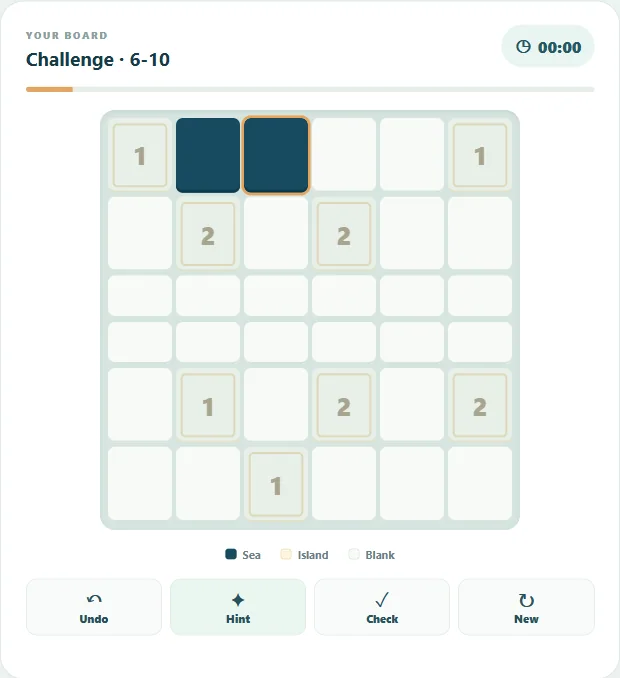
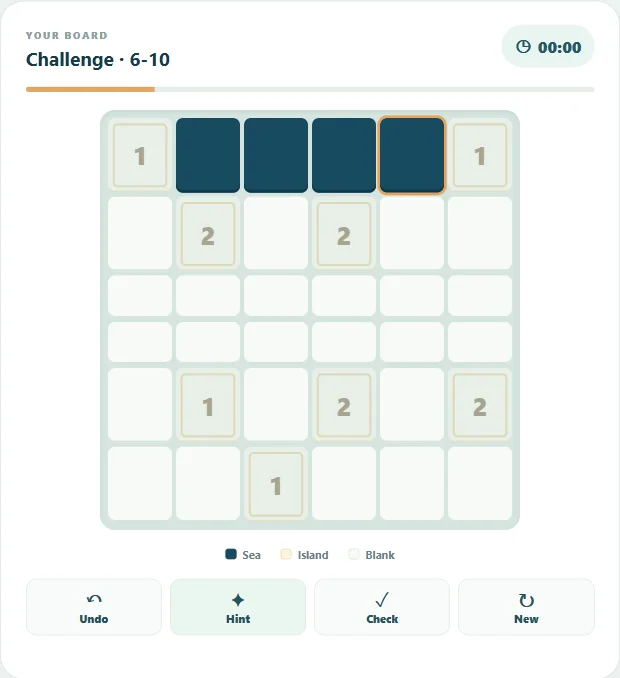
Click or tap cycles an undecided cell through sea and island states. Desktop right-click marks island. Arrow keys move focus, Space or Enter cycles, and one or two selects sea or island respectively. Z undoes and H requests a hint. Check examines marked cells, while Hint supplies a correction. Watch the resulting state rather than assuming repeated taps always mean the same action.
Unfinished progress and statistics are saved locally, together with up to two hundred new undo changes. There is no cloud-save adapter for this game. Changing browsers, profiles or domains can therefore produce a different local state. Use help to understand a stalled area, but do not treat a revealed correction as evidence that every earlier guess was justified.
Finish with three independent audits
Inspect the completed islands first: exact size, one clue and edge connectivity. Then follow the sea to confirm that every water square can be reached without diagonal jumps. Finally scan all two-by-two windows for prohibited solid water. Passing one audit does not imply that the other two are correct.
For your next board, practise recognising completed islands and naming the water passage each new boundary preserves. The links below lead to the current Nurikabe build and related games. Fillomino also explores region sizes, but its clues and equal-number merging work differently; Akari asks about rays rather than water. Those comparisons help you choose another thinking challenge without carrying over the wrong rules.
Keep playing
Every game page lists its current version and controls and offers a fullscreen play view.
Explore the collection: Logic Puzzle Games