
Killer Sudoku strategy: cage combinations, residual sums and the rule of 45
Killer Sudoku supplies totals instead of relying only on starting digits. A cage's cells must add to its printed sum without repeating a digit, while the ordinary row, column and box rules still apply. The most productive approach combines small combinations with careful counting of entire units. This guide explains both, including the boundary mistakes that can make a neat subtraction wrong.
Keep both rule systems active
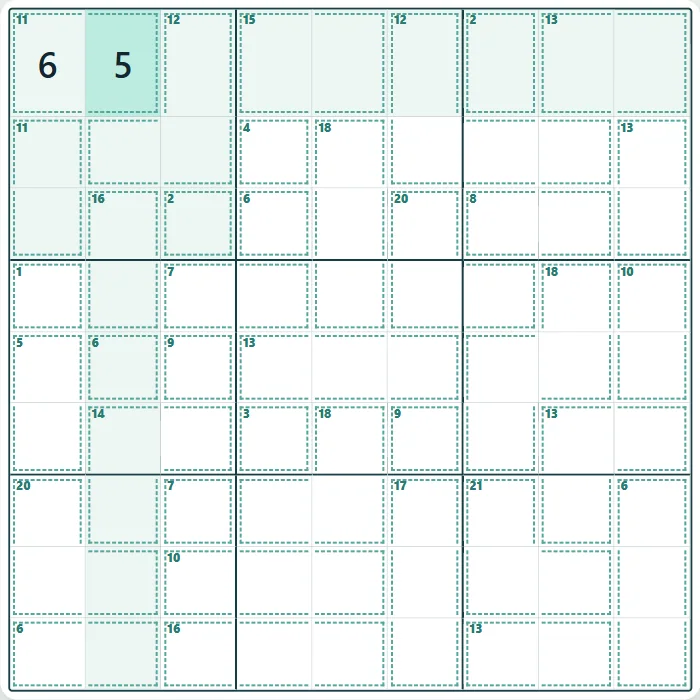
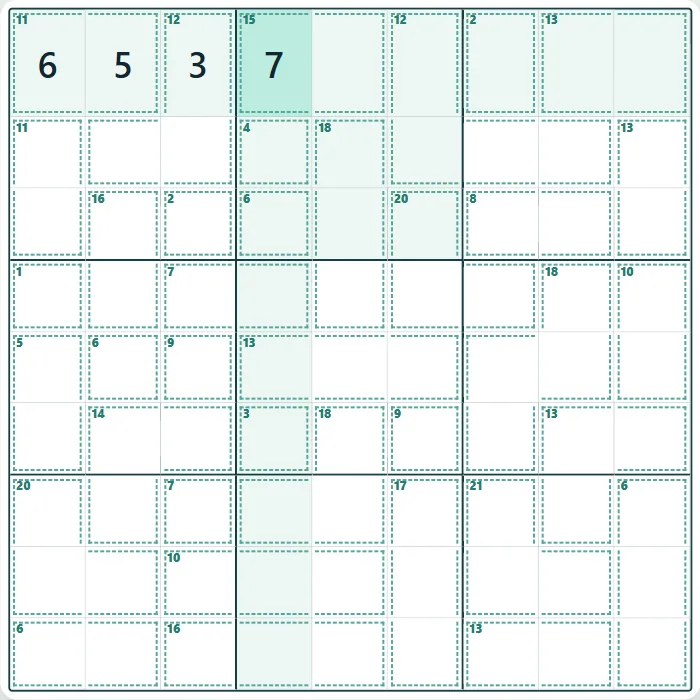
Every row, column and three-by-three box contains one through nine once each. A cage adds an exact sum and its own no-repeat condition, even when it crosses box boundaries. A pair of digits that adds correctly can still repeat a value in a column. A valid Sudoku placement can still violate its cage's remaining sum.
The small printed cage number is a total, not a digit to enter in the first cell. Follow the cage outline and count its cells before calculating possibilities. Box boundaries and cage boundaries identify different groups. Arithmetic techniques work with sets of cells, so knowing which set you are adding is essential.
The available edition uses a nine-by-nine board at every difficulty. Difficulty changes the cage distribution and sizes, not the grid dimensions. Learn how a cage interacts with a row or box before looking for a larger board as the definition of a harder puzzle.
Start with restricted combinations
A two-cell cage totalling three must contain one and two. A total of four requires one and three because two plus two repeats a digit. Seventeen requires eight and nine. These observations determine the pair as a set, but may not determine which cell receives which value.
For a two-cell total of eleven, the possible distinct pairs are two-nine, three-eight, four-seven and five-six. If one cell's row already contains nine, the pair two-nine may still be possible with nine in the other cell. Check the assignment, not merely the presence of a forbidden candidate somewhere in the pair.
Reject a whole combination only when neither ordering can satisfy the relevant constraints, or when a condition genuinely affects the entire cage. Record positional candidates separately from the cage's combination list. That distinction prevents a local row restriction from eliminating a pair that works in its reversed arrangement.
Why complete units sum to 45
One through nine total forty-five, so every complete row, column and box has that sum. Suppose whole cages contained entirely inside a box cover eight of its cells and their totals add to thirty-eight. The remaining cell is seven. The calculation is useful because the covered cells are known precisely, not because the labels happen to be printed near the box.
Do not include the entire total of a cage that extends outside the unit unless you also account for its outside cells. That extra value changes the equation. Trace the outlines and identify missing or extra squares before subtracting. The rule of forty-five is ordinary arithmetic over a correctly chosen cell set.
If two cells remain uncovered instead of one, the subtraction gives their combined total, not individual digits. A residual total of seven allows one-six, two-five or three-four before other constraints are applied. This is still helpful, but it should become a candidate relation rather than two guessed placements.
A worked outside-cell example
Imagine several complete cages that cover all nine cells of a box and exactly one extra cell just outside it. Their cage totals add to forty-nine. The box contributes forty-five, so the outside cell must be four. Check that no box cell was omitted and no second outside square was accidentally included.
Now change the scenario: one box cell is missing from the cage set, while one outside cell remains included. The same subtraction gives outside minus missing inside, not the outside digit by itself. If the difference is four, an outside nine and inside five could satisfy it, among other possibilities. You need another constraint to decide the values.
This contrast is worth drawing on paper. Label the cells being counted, then cancel the nine box cells against the unit total. Any uncancelled squares explain exactly what the subtraction means. Once you obtain a digit, verify its row, column and cage as well; a calculation must coexist with the other rules.
Use cage sets to reserve digits
A three-cell cage with total nine can use one-two-six, one-three-five or two-three-four. Enumerate those alternatives rather than assuming the smallest-looking values. By contrast, total six forces one-two-three. If all three cells of that six-cage lie in one row, those values are reserved there and cannot appear elsewhere in the row.
If the same cage crosses two rows, that full-row reservation is unavailable. Only the actual cells and their current positional possibilities matter. A familiar set pattern should not erase the importance of its geometry. This is the same discipline used when checking the boundary of a forty-five calculation.
After placing a digit, reduce the cage's outstanding total and remove that digit from its remaining combination options. A three-cell fifteen with a fixed eight leaves two distinct values summing seven, neither equal to eight. Then intersect those possibilities with each cell's row, column and box candidates. Keep notes current as the arithmetic changes.
Tools and puzzle supply in this edition
The published collection contains twelve uniquely solvable boards, four at each of three difficulties. Its local-date daily challenge applies a deterministic transformation to a Medium board. This is finite puzzle material, not an unlimited stream of wholly new boards. There is no time limit or loss screen for spending longer on a deduction.
Click or tap to select a cell and use one through nine for an entry. Arrow keys navigate, N toggles notes, and Delete, Backspace or zero clears. Z undoes and H requests a selected-cell hint. Pause and Menu stop the active clock. Confirm that notes mode is enabled before entering several possibilities so that you do not replace a final digit accidentally.
Saves and statistics are browser-local, including up to one hundred newly recorded changes recoverable for undo. New hint-free completions have a separate record. A local save does not imply cross-device cloud progress or an active public competitive ranking. A revealed digit can teach you what a stalled cage needed, but it does not validate every earlier assumption automatically.
A focused practice plan
On a new board, look for a restricted cage combination, a complete-unit subtraction and a set of cage digits confined to one row or column. These are observation goals, not a promise that every puzzle exposes all three at the opening. If a pattern is absent, keep its candidates open and inspect another relation.
When a contradiction appears, review the boundary of your most recent sum first. Then check cage repetition and ordinary unit repetition. This sequence targets common mistakes without requiring you to erase the entire grid. Use the linked Killer Sudoku page for the current build. Classic Sudoku shares the unit rules, while Futoshiki replaces cage arithmetic with ordering constraints. Those comparisons help you choose another number puzzle without treating its additional rule as interchangeable.
Keep playing
Every game page lists its current version and controls and offers a fullscreen play view.
Explore the collection: Logic Puzzle Games