About Go · Quiet Stones
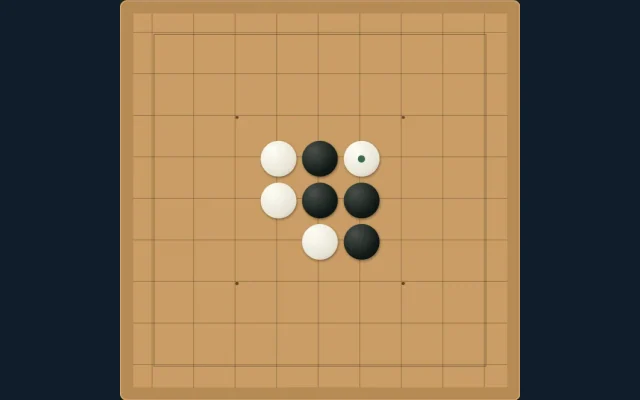
Quiet Stones offers three Go board sizes with a clear distinction between solo and shared-device play. Challenge the computer on 9×9 at three difficulty levels, or play a local two-person game on 9×9, 13×13 or 19×19. Groups are captured when their last liberty disappears. After two passes, review dead groups before accepting the area score; resume play when a group’s status is uncertain. Board magnification makes larger grids easier to use. Active games and wins by stone color stay in this browser.
How to play
Choose a board and mode, then start. Black places the first stone. Select an empty intersection to play; suicide and repeated board arrangements are rejected. Passing twice opens scoring review. Mark dead groups only when appropriate, then confirm the score or resume play. Undo is available during an unfinished game.
Rules in this version
- Orthogonally connected stones form a group. Adjacent empty intersections are its liberties; losing the final liberty captures that group.
- Suicide is forbidden. Positional superko prevents repeating any earlier board arrangement.
- Area scoring counts living stones plus surrounded territory. White receives 6.5 komi; captured stones are not counted a second time.
- Two consecutive passes open dead-group review, with explicit confirmation or a return to play.
- Computer play uses 9×9. The 13×13 and 19×19 boards support two people on the same device.
Tips for playing
- Connect vulnerable stones before racing to capture an opponent. Count liberties rather than judging a group by its size.
- A surrounded group can still live. Resume play instead of accepting a disputed dead-group mark.
Questions about this game
Which boards support computer opponents?
The 9×9 board has three computer difficulty levels. Larger boards use local two-player play.
Does this use the complete AGA tournament rules?
No. This edition explicitly combines area scoring, positional superko, no suicide and 6.5 komi, with manual dead-group review.
Game screenshots