
Spider Solitaire rules: moving runs, suits and empty columns
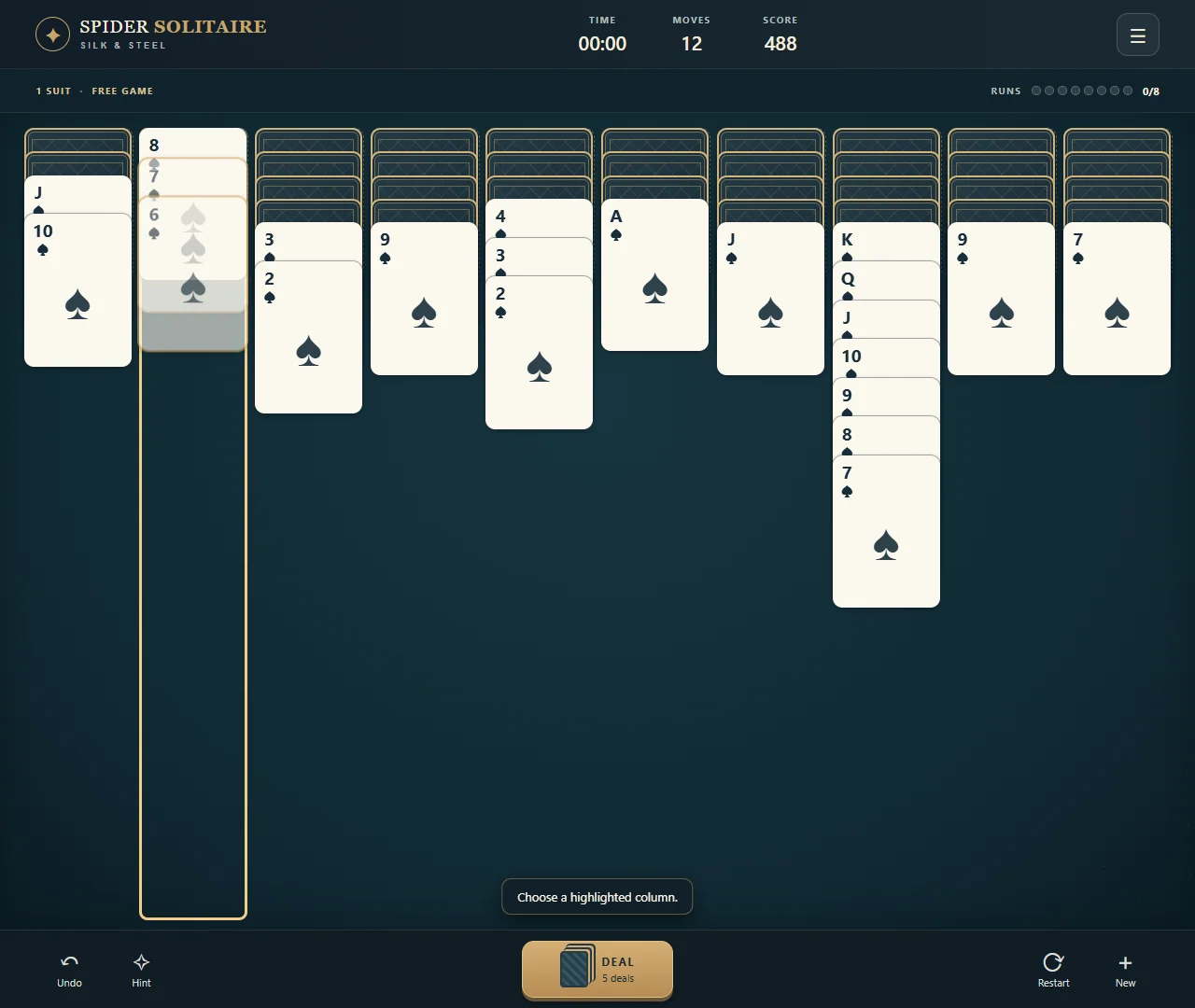
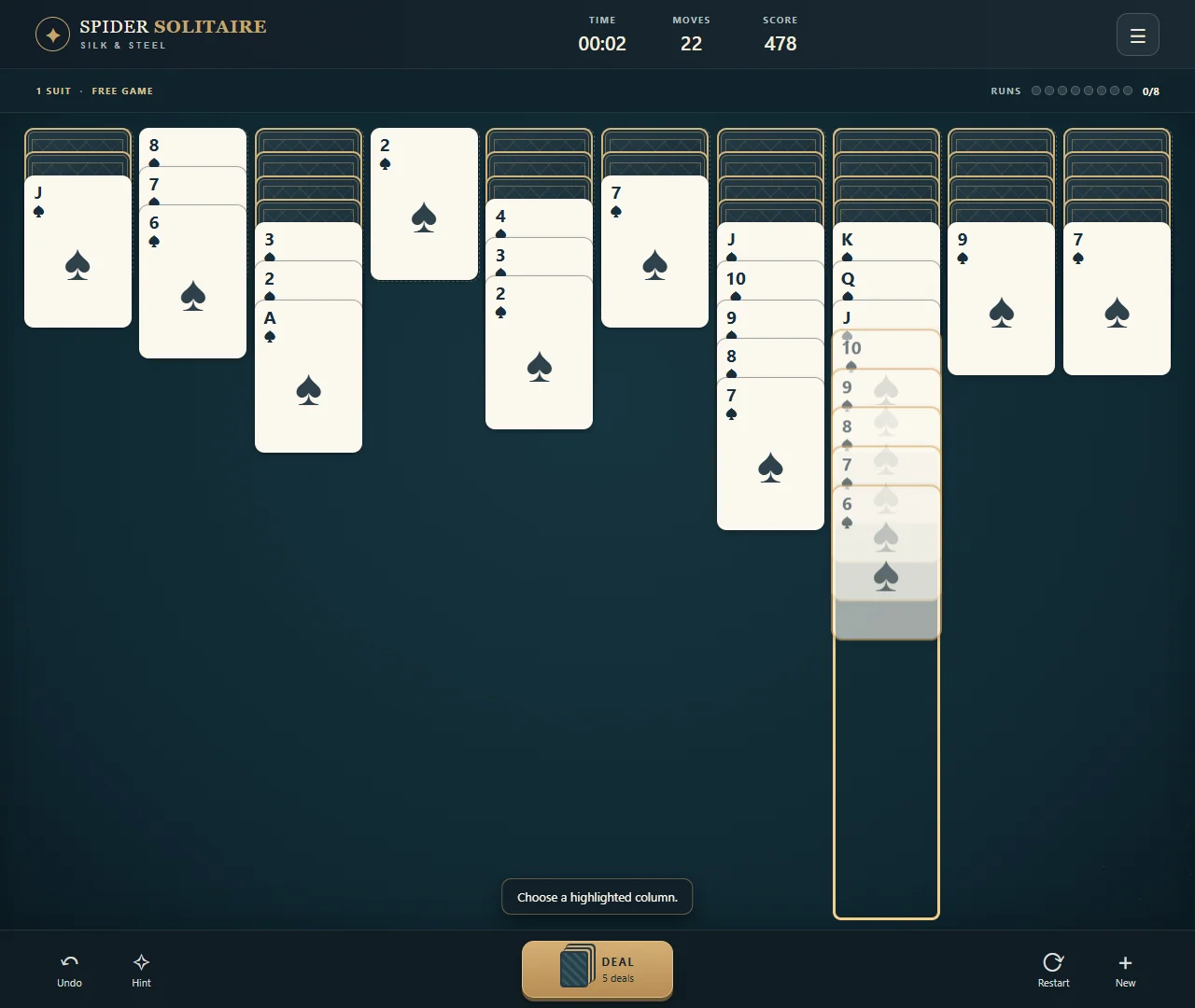
A descending column is not necessarily a movable run. Spider lets you build on the next rank regardless of suit, but moving several cards together requires a single-suit sequence. That distinction explains many blocked moves.
Clear eight king-to-ace runs
Spider uses 104 cards. The first four of its ten columns receive six cards and the other six receive five, with only each column's final card face up. The 50 remaining cards provide five stock rows of ten.
A complete face-up king-to-ace run of one suit is removed automatically. Clear eight such runs to win. This is not Klondike's ace-upward foundation building, and exposing every hidden card is not itself a victory.
Placement and group movement have different tests
A movable card or run can be placed on a card one rank higher without matching the destination suit. Within the moving group, however, every card must be face up, descend one rank at a time and share a suit.
An eight of spades above a seven of hearts cannot move together. The seven can move alone to a suitable eight. An eight-seven-six of spades can move as a run onto a nine of hearts, but the resulting mixed-suit join does not become one movable group.
Use an empty column before you refill it
Any card or valid run can occupy an empty column; kings do not have exclusive access. The space can help separate mixed suits and assemble a uniform run. Moving a whole column into another empty column does not expose anything new by itself.
Every column must contain a card before a stock row can be dealt. Even one empty column blocks the deal. Use the working space deliberately, then refill it if you decide to draw. A stock deal adds one card to all ten columns rather than showing one card on a waste pile.
The suit count changes conflicts, not the basic rules
One-, two- and four-suit modes retain the same placement and dealing rules, with 104 cards and eight completed runs. In one suit, any face-up descending chain meets the suit condition. Extra suits create mixed joins that must be separated before those cards travel together.
Try one suit to practise exposing cards and using empty columns, then track same-suit groups in the other modes. This guide supplies no unsupported win percentage or promise that every deal can be solved.
Review moves without treating a hint as a solver
Our hint ranks local moves using factors such as exposing a card and joining suits. It avoids immediately reversing the last move, but it does not prove a winning continuation. A missing suggestion is not a replacement for inspecting the board.
Undo restores an earlier position before victory; the won result is protected from undo. Progress and statistics are local. Open the game page for the current controls and build, or use the Solitaire selection guide when you want a different constraint such as free cells or value pairs.
Keep playing
Every game page lists its current version and controls and offers a fullscreen play view.
Explore the collection: Solitaire Games