
Golf Solitaire rules: plan a run and check the king rule
Golf Solitaire is a removal game, not a game of building columns or foundations by suit. Your target is the 35 tableau cards. Every card you remove changes the waste rank, so choosing between two legal moves means looking at the cards each move will uncover.
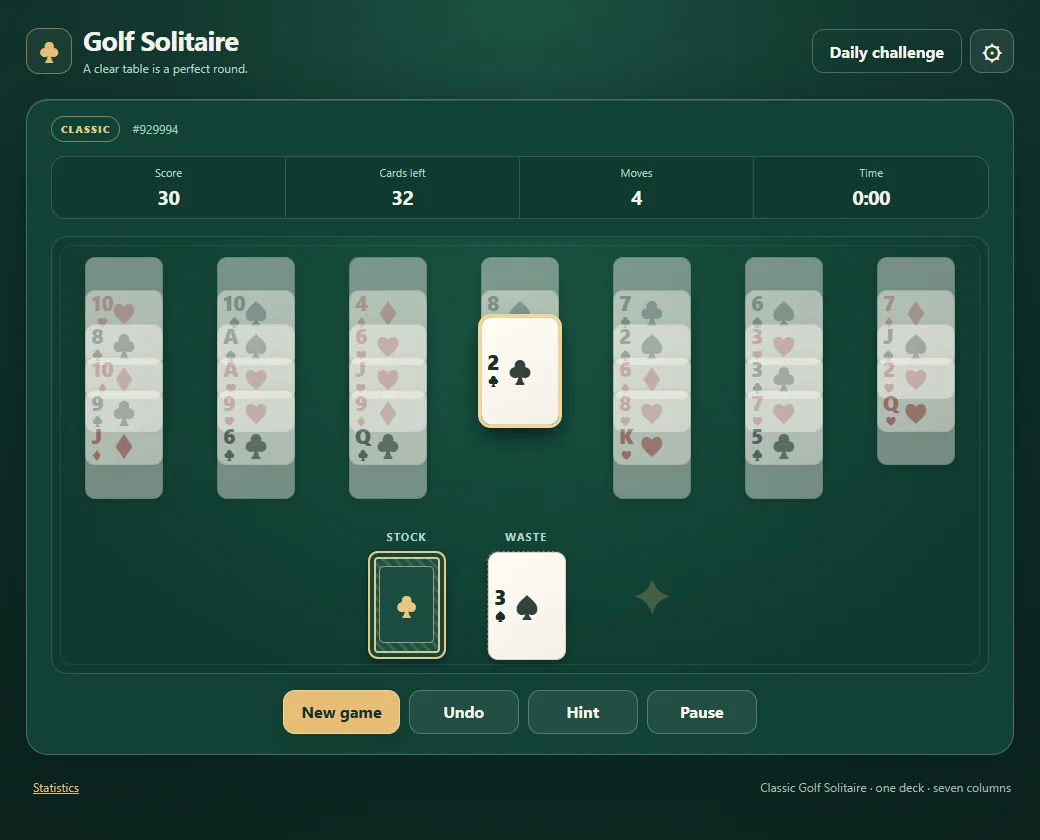
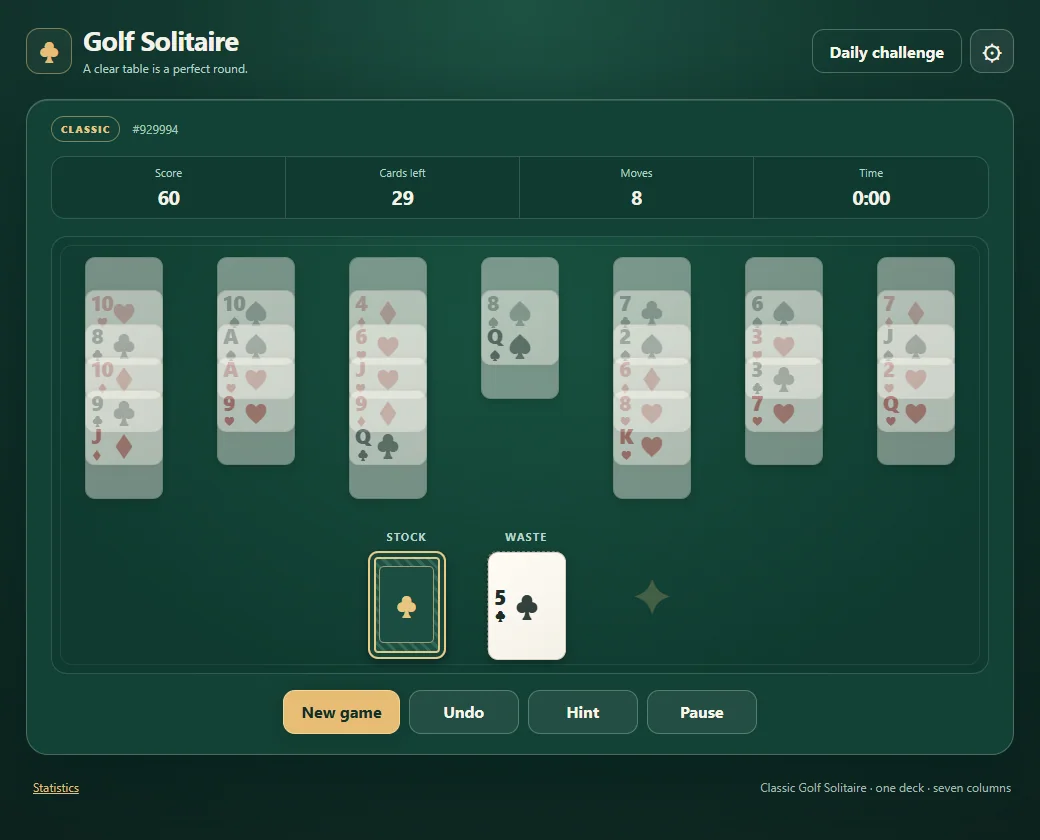
Read the layout and the available cards
The deal has seven face-up columns of five cards, one starting waste card and 16 stock cards. Only the exposed end card of each column can be removed. Seeing a card farther up a column does not make it available yet, and you do not move cards between columns or fill empty spaces.
Remove an available card one rank above or below the waste. Suits and colours do not matter. A waste 7 accepts a 6 or an 8; a jack accepts a 10 or queen. The removed card becomes the new waste, which means you must check the available ranks again after every move.
No wrap does not mean every king ends a run
Our edition allows ace↔2 and queen↔king, but not ace↔king. A queen → king → queen run is legal if the second queen is exposed. King → ace is not. This matters because some other Golf editions stop a run at a king, while others allow the ranks to wrap around.
Check the actual game's rule before applying a strategy from another edition. A tip that assumes kings are terminal would discard a legal queen move here; a tip that assumes wrapping would suggest an illegal ace. The current game page identifies the browser version used by this guide.
Choose the next exposed card, not just the next rank
With a 7 on the waste, both an exposed 6 and 8 may be legal. Look one step farther: removing the 8 might expose a 9, while removing the 6 might expose a 5. Compare the potential 7 → 8 → 9 and 7 → 6 → 5 runs before committing.
Two exposed cards of the same rank are not always equivalent. They uncover different cards and can leave different bottlenecks. A longer immediate run is useful, but it is not proof of a winning route. You cannot infer the unseen stock order, and this guide does not claim that every deal is solvable.
Spend the stock carefully and recognise the ending
Drawing replaces the waste with the next stock card. You are allowed to draw even when a tableau move exists, but the stock is finite and cannot be recycled. Check all seven exposed cards and their continuations before using another draw simply because the first move you saw looked unhelpful.
You win when all 35 tableau cards have been removed. An empty stock does not immediately end the game if a legal tableau move remains. You lose only when cards remain, the stock is empty and no exposed card is adjacent to the waste.
Use the tools to compare decisions
This edition provides hints, undo during active play, pause, a daily deal and local statistics. A hint identifies an available move rather than certifying a winning continuation. Undo can help compare two choices while a round is still active; observe which card each choice exposes instead of replaying blindly.
The daily deal follows the UTC date, not necessarily your local midnight. Replays can help you learn a particular layout, and local statistics are not a global leaderboard. If you enjoy removing exposed cards but want a different constraint, Pyramid asks you to make pairs totalling 13 rather than adjacent-rank runs.
Keep playing
Every game page lists its current version and controls and offers a fullscreen play view.
Explore the collection: Solitaire Games