
Pyramid Solitaire rules: exposed cards, pairs and the redeal
Pyramid Solitaire lets you see cards you cannot use yet. Finding a pair worth 13 is only half the task: both cards must be available. This guide explains our browser edition's exposed-card rule, waste pile and single recycle, then shows how to compare two legal removals.
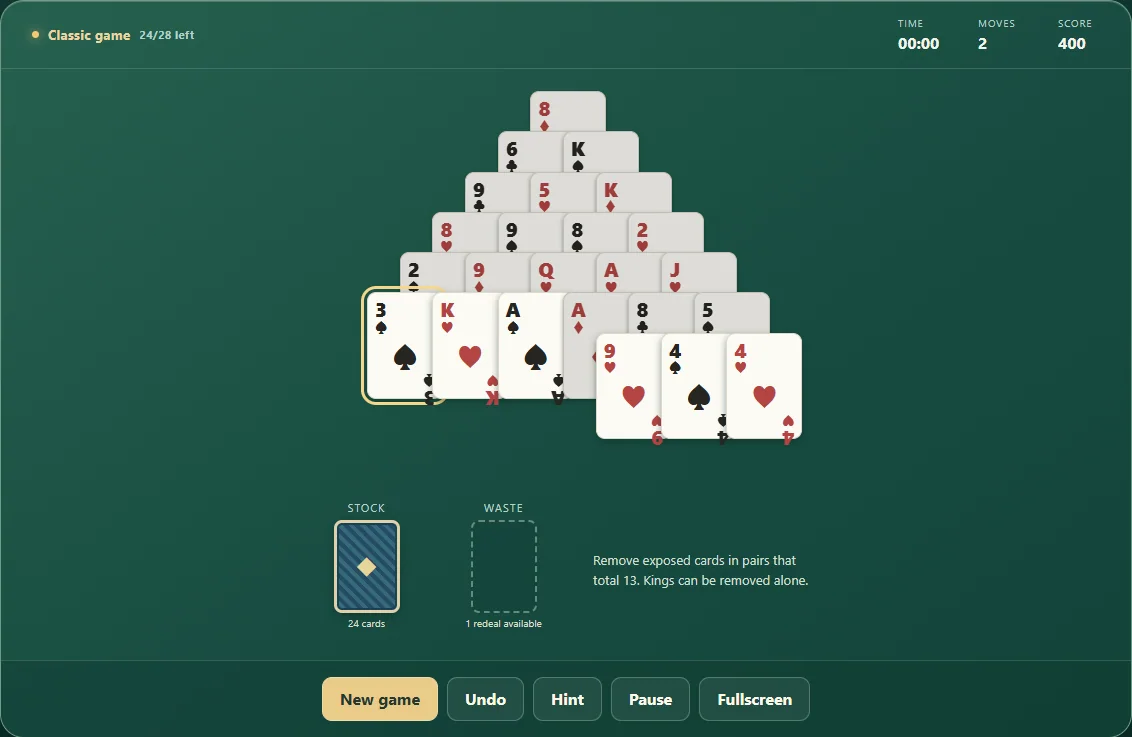
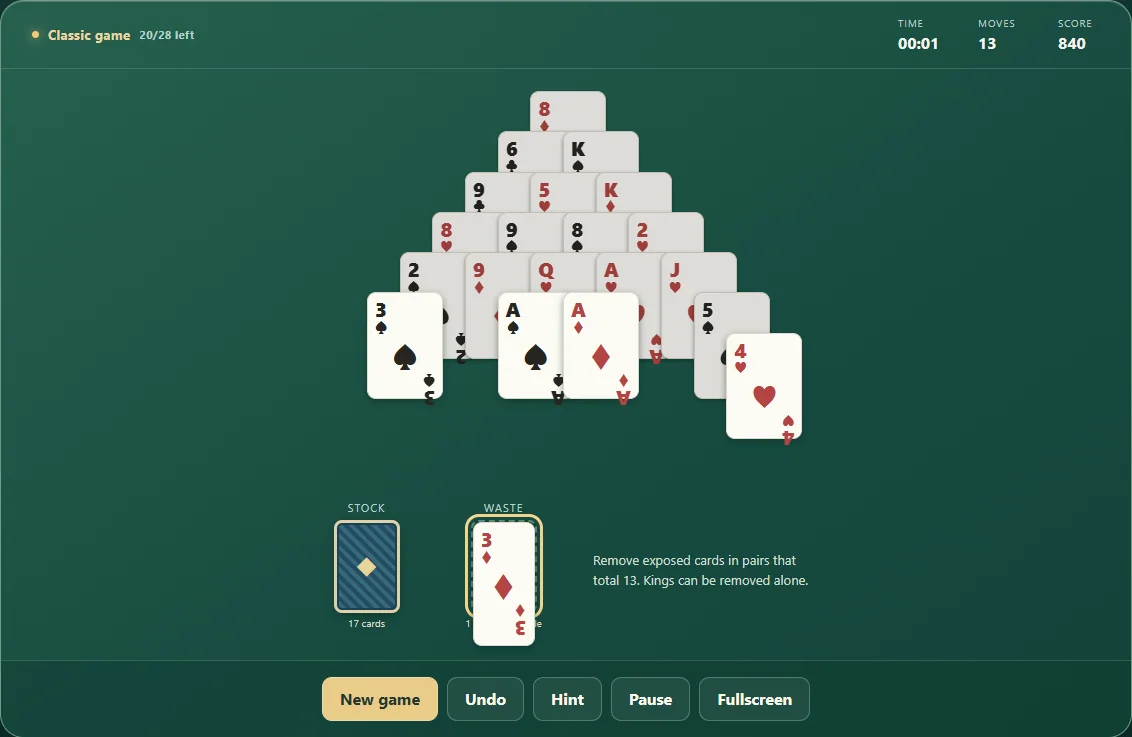
The pairs and the winning condition
Aces count as 1, jacks as 11, queens as 12 and kings as 13. The pairs are ace+queen, 2+jack, 3+10, 4+9, 5+8 and 6+7. An available king needs no partner. Suits and colours do not affect whether a removal is legal.
Clear the 28 cards arranged in the seven-row pyramid to win. Cards can remain in the stock or waste. There are no suit foundations or descending tableau sequences to build: each move removes an available king or a legal pair.
An exposed card has no remaining cover
The bottom row is available at the start. A card higher in the pyramid becomes available when the cards covering it in the next row have gone. Removing just one cover does not release it when the other still remains.
Both cards must already be exposed before you select a pair in this edition. You cannot combine a free card with the covered card it would release, even if the total is 13. Some Pyramid variants allow that covering-pair exception; this build does not. Only the top waste card is available, not any card you can see farther down the waste.
What the stock and single recycle allow
Drawing moves the next stock card onto the waste. Pair the top waste card with an exposed pyramid card, or remove it alone if it is a king. Removing it can reveal a useful card underneath, so check that new top before drawing again.
Once the stock has been dealt through, our edition lets you recycle the waste once. It is not unlimited. A card that had no partner on the first pass may become useful after the pyramid opens, but you cannot plan around a third pass. Guides for other tables may describe zero, two or unlimited recycles instead.
Compare what each legal pair exposes
Look above a possible pair before removing it. One choice can free a card immediately while another leaves both higher cards partly covered. The useful question is not simply which pair you found first, but which new partners that pair makes available.
For example, two exposed 5s can both match an 8 on the waste. Compare the card each 5 would release and whether its partner is still accessible. Opening a card is usually worth considering, but it is not an absolute rule or a proof of a winning path. Seeing the pyramid does not mean every deal can be cleared.
Use the tools and understand a blocked round
The round is won as soon as the pyramid is empty. A blocked round ends when there is no further stock draw or recycle and no exposed king or legal pair remains. Reaching the end of the stock for the first time is therefore not necessarily a loss.
This build offers hints, undo during active play, optional pair highlighting, pause, a daily deal and local saving. A hint locates a removal, not a complete winning solution. Use undo to compare the cards two choices expose. For a related removal game with a different rule, Golf uses adjacent ranks rather than pairs totalling 13.
Keep playing
Every game page lists its current version and controls and offers a fullscreen play view.
Explore the collection: Solitaire Games