
How to solve crosswords: clues, crossings and review
A crossword is not a sequence of isolated clues. Every answer supplies letters that constrain the Across and Down entries it meets, so the grid can confirm an idea or expose a wrong one early.
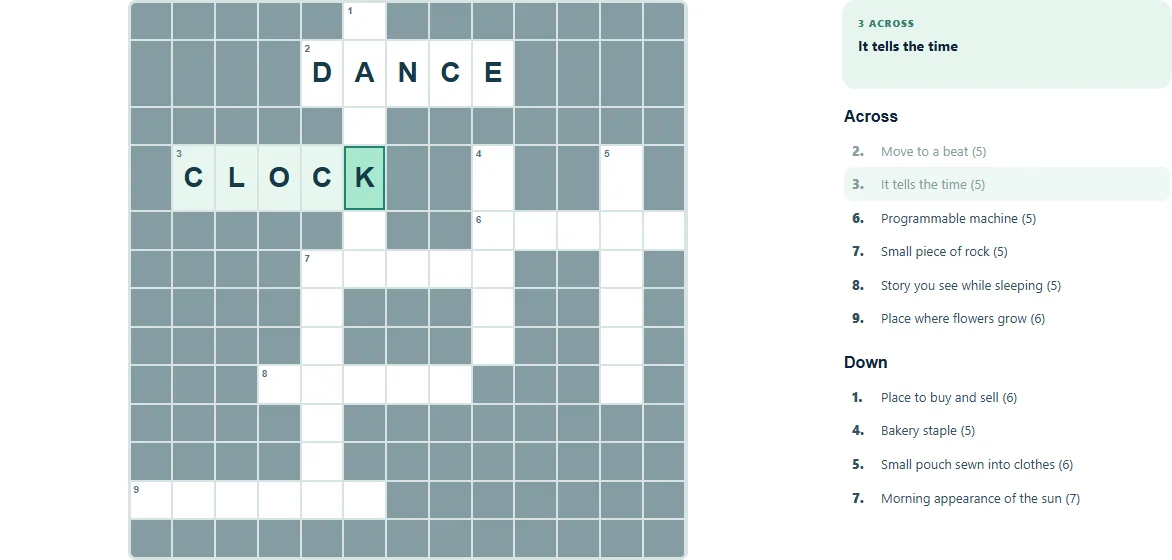
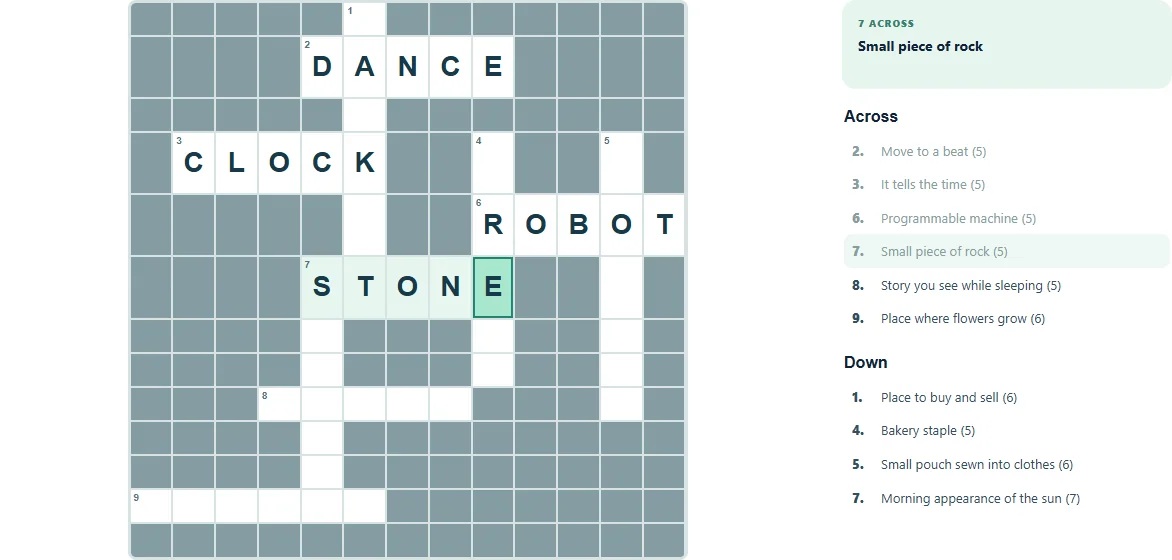
Begin with answers you can support
Make a first pass through Across and Down clues and enter only answers that clearly fit their definition. A plausible word is not yet a secure answer when the clue permits another reading and no crossing letters support it.
Every confirmed entry gives letters to another direction. A short, certain clue can therefore be more useful than a long answer that only feels familiar. Return to difficult clues after the letter pattern has narrowed their options.
Treat crossings as evidence
When two answers meet, the shared letter has to work for both clues. If a proposed answer breaks a crossing, reread both definitions instead of assuming that the most recent word must be wrong.
Check the shape of the answer too: singular or plural, verb or noun, and the letters already fixed. A pattern turns a broad clue into a smaller set of compatible words.
Build one connected area at a time
Once several answers are in place, choose a part of the grid with many crossings and try to settle another certain entry there. Completing a connected corner usually produces more useful information than jumping between unrelated empty clues.
Leave an answer open when it works only because you forced a doubtful letter. The aim of an early pass is not a full grid; it is a growing set of letters that each have support from a clue and its crossings.
Review before checking, then use the daily puzzle
The published build lets you select a square or a clue, switch direction by selecting the same cell again, and type with keyboard, mouse or touch. Tab moves to another clue, arrows advance and Backspace erases; the clue list remains available on mobile.
Use Check after reviewing your crossings, rather than replacing that review. Daily Crossword has a UTC daily challenge and Quick Play for another grid; progress, undo history and statistics stay locally in the browser.
Keep playing
Every game page lists its current version and controls and offers a fullscreen play view.
Explore the collection: Word Games