
Dots and Boxes rules: extra turns, shared edges and chains
A Dots and Boxes score counts completed squares, not the number of lines you drew. Closing a square lets you keep moving, which can turn a small opening into several captures. Read the boxes on both sides of a proposed edge before deciding that a move is harmless.
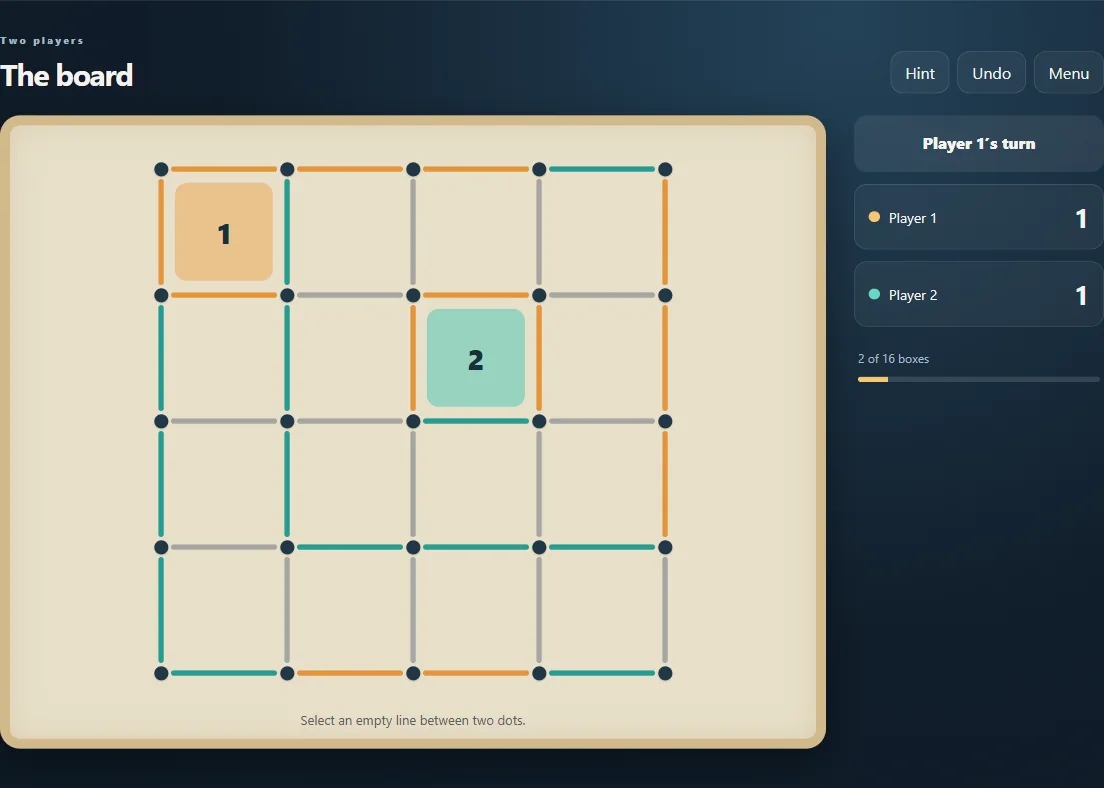
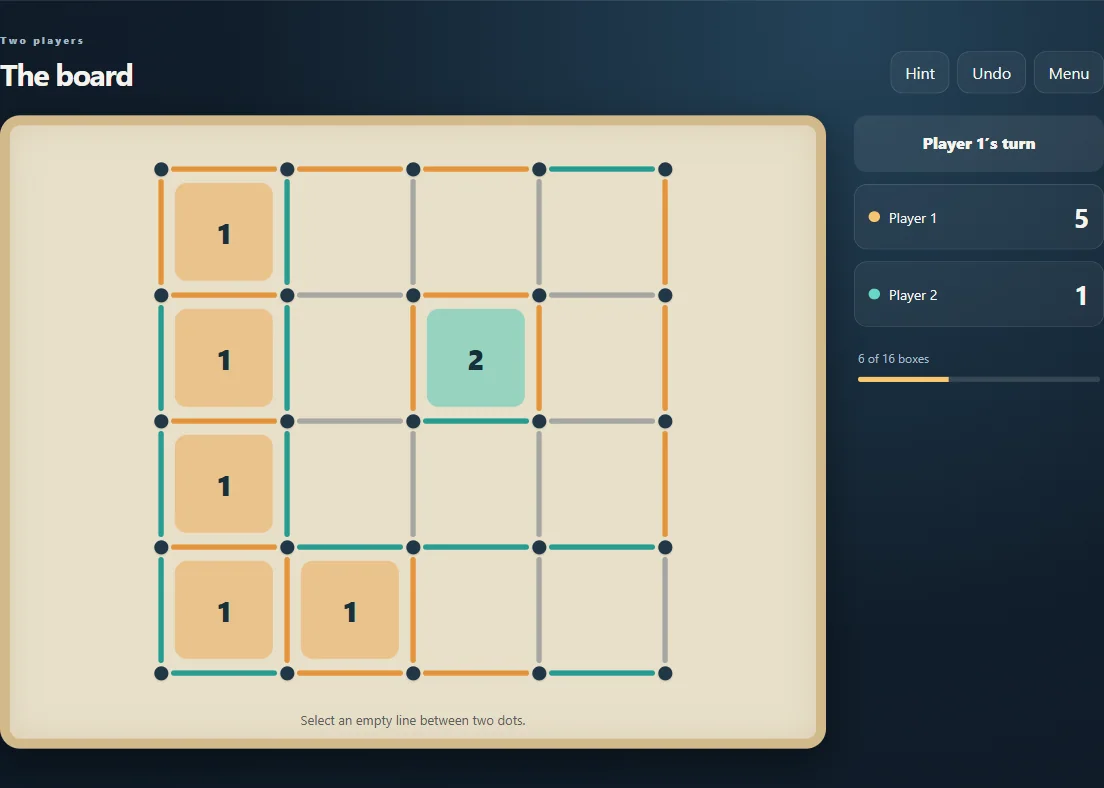
Claim the last edge, not the earlier work
Choose an unused horizontal or vertical segment joining neighbouring dots. Diagonal lines and already occupied segments are unavailable. Whoever supplies a square's fourth edge owns it, even when the opponent drew its other three.
An edge that completes no square passes the move to the other player. Complete one square or two and you retain the move, provided the board is not finished. A double capture is two points, not a bank of two extra turns. Once every edge is occupied, the higher box total wins; equal totals draw.
Check both sides of an interior edge
Picture two adjacent squares with all six outside edges drawn and their shared divider empty. Drawing that divider closes both squares at once. The player scores twice and can choose another edge while any remain.
Before drawing a non-scoring edge, count the occupied sides of each neighbouring square. Turning two sides into three offers an immediate capture. An outside edge touches only one square, whereas an interior edge can be safe on one side and expose a box on the other.
Follow the captures beyond the first point
For a concrete chain, imagine three squares in a row with their top, bottom and left boundary already drawn. Close the first internal divider: it claims the first square and becomes the next square's third side. Repeating along the row collects all three while keeping the move.
Compare the run you may concede rather than counting only an immediate point. Once every remaining non-scoring edge exposes a square, some concession can be unavoidable. Certain endgames reward giving boxes back to control later chains, but automatically leaving two boxes is not a general winning rule. Score, connections and remaining free edges decide whether that trade is useful.
What our hint and undo actually do
Hints use the Hard move-selection logic. With at most twelve free edges it evaluates the final box differential; earlier it uses capture opportunities, safe edges and chain concessions. An early hint therefore does not certify perfect play across the entire game.
Undo in local two-player mode removes the most recent edge. Against the computer it can roll back more than one action to return a human decision. The Daily challenge disables undo, as does a finished result. Examine a fork before finishing if you want to compare alternatives.
Choose a board and practise the decisions
The 3×3, 4×4 and 5×5 settings count boxes: nine, sixteen and twenty-five, rather than that many dots. Local two-player play shares one device and creates no remote room. Mouse or touch selects an edge; arrow keys navigate available segments and keyboard activation draws the selected one.
Daily play fixes a 4×4 board, Hard difficulty and a UTC date. Saves and records belong to the current browser, with no promise of cross-device or cross-domain transfer. The game page opens the published build. Our shared-device selection compares this extra-turn rhythm with Connect Four gravity and Reversi passing, rather than repeating these rules.
Keep playing
Every game page lists its current version and controls and offers a fullscreen play view.
Explore the collection: Board Games