
How to solve Tangram puzzles: seven pieces and silhouettes
A Tangram always uses the same seven pieces: two large triangles, one medium triangle, two small triangles, a square and a parallelogram. Solving a silhouette means using all of them with no gaps or overlaps.
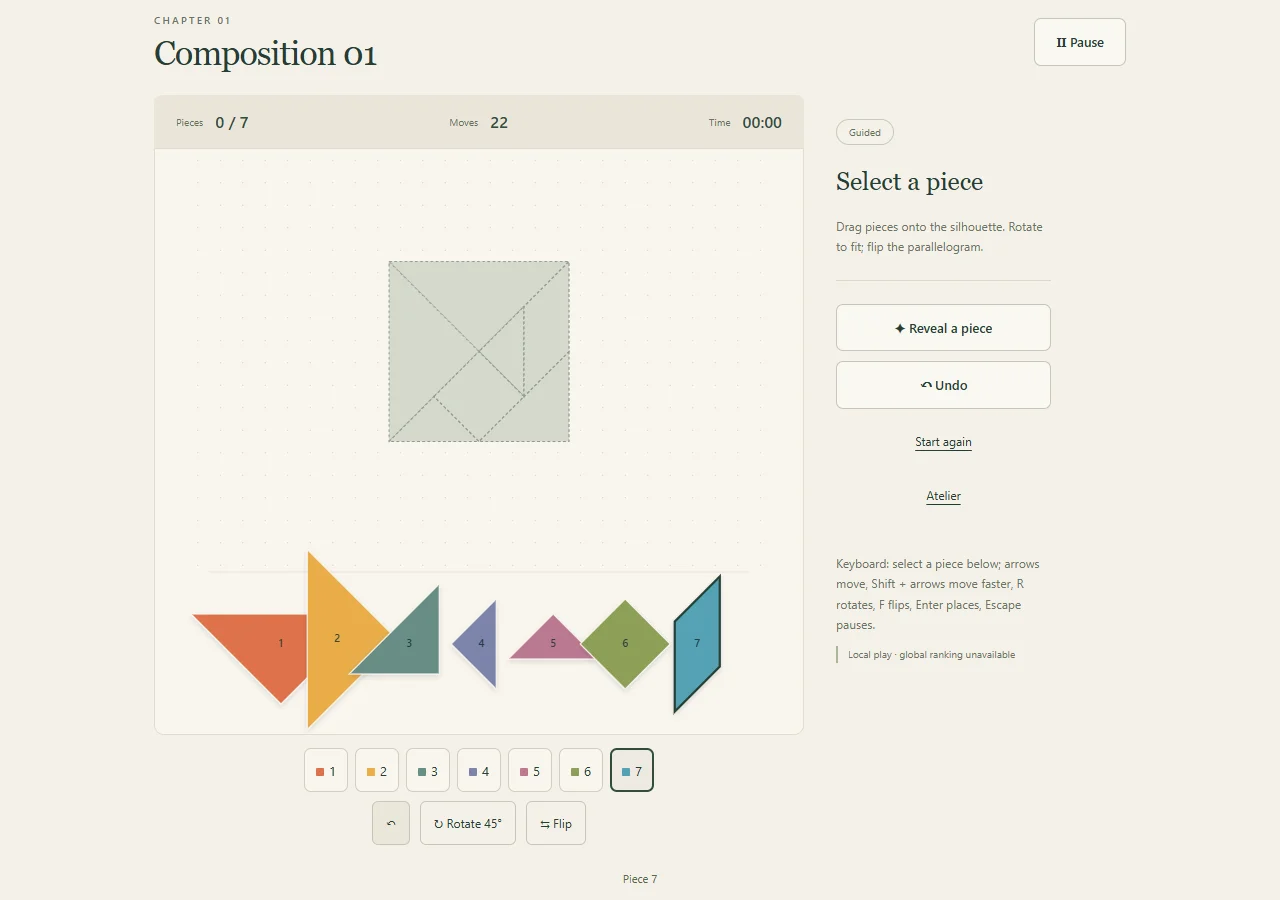
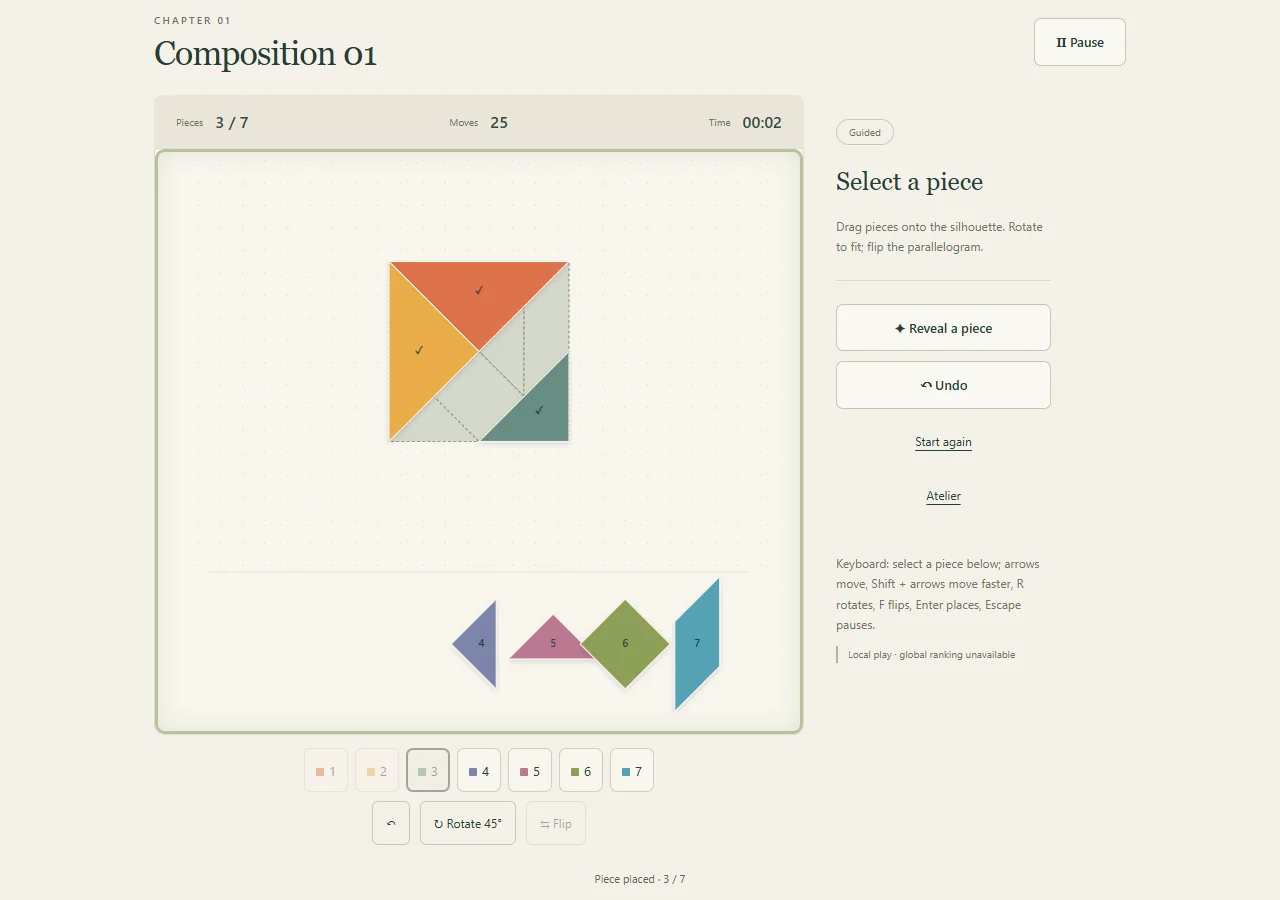
All seven pieces must fit
The basic rule stays the same for every silhouette: use each of the seven pieces once and never overlap them. A figure that looks complete with six pieces is not a valid solution.
Before moving anything, notice the relative size of the two large triangles, medium triangle, two small triangles, square and parallelogram. That prevents trying to cover a large region with a piece that cannot reach it.
Read corners and the outline
Look first for wide angles, long points and large regions in the silhouette. They often limit which piece can reach that edge. There is no universal order: a distinctive corner can be a better starting point than a large piece.
Test a position and observe the outline it leaves for the remaining pieces. A plausible placement that leaves an impossible gap is useful information; rotate or move it before filling the centre by habit.
Rotation and flipping are different
Triangles and the square change orientation by rotating. The parallelogram adds a separate decision: some silhouettes require its mirror image, so it must be flipped as well as rotated.
Tangram Atelier rotates pieces in 45-degree steps and lets you flip the parallelogram. Guided mode shows outlines, Silhouette mode leaves the arrangement to you, and Sprint gives four minutes for a solution.
Practise in Tangram Atelier
The published version has 24 abstract compositions and a UTC daily puzzle. Hints place a piece and Undo reverses the last move; both mark the run assisted. Records stay local and global rankings are disabled in this version.
Drag a piece to the silhouette or use the keyboard: `1–7` selects, arrows move, Shift speeds movement, `R` rotates, `F` flips and Enter places. The playable page keeps the current build and controls; this guide focuses on learning to read a silhouette.
Keep playing
Every game page lists its current version and controls and offers a fullscreen play view.
Explore the collection: Puzzle Games